

You’re probably brilliant at coming up with creative ways to teach science, but what about those really classic brain-ticklers? You know, the ones that have been baffling people for hundreds, maybe thousands of years? Well, today, you’re diving headfirst into one of the biggest ones: Chicken or the Egg. Honestly, it’s the ultimate riddle for exploring evolution with your class. Think about it: it perfectly blends simple, relatable animals with seriously complex ideas about life's origins and how creatures change over time. It’s a fantastic way to spark that critical thinking and problem-solving spirit you love to see! At Inspirational Science For Subs, you know the goal is always to go beyond the textbook, and this topic lets you do just that. You can get your young scientists thinking like true biologists, piecing together the timeline of life. So, how can you turn this age-old question into an engaging lesson that inspires your students? You’ll find some great, easy-to-use concepts right here. You won’t have to waste time inventing activities; you’ve got some excellent foundations ready to go!
More...
Chicken or the Egg: Breaking Down the Biology
It seems like such a simple question, doesn’t it? The Chicken or the Egg? But it’s actually a brilliant way to introduce your students to core concepts of biology, especially evolution. When you talk about the chicken itself, you’re talking about a highly specialised animal. It's the final, modern version of a bird, but it certainly didn't just pop into existence. Every single trait that makes a chicken a chicken—from its comb to its cluck—came from its parents. And those parents were slightly different from their parents, and so on, stretching back millions of years! That's the essence of evolution: small changes piling up over huge amounts of time. You see, the modern chicken, the Gallus gallus domesticus, is the result of countless tiny genetic tweaks. That’s a powerful idea for your young learners to grasp! You can discuss how the first animal that was exactly what we call a chicken had to hatch from an egg. But wait a minute, whose egg was it? The creature that laid that specific egg wasn't quite a chicken yet; it was its immediate ancestor! That ancestor was almost a chicken, but not fully the modern kind. This is where the great evolution puzzle truly begins!
What Came Before the Chicken?
To understand the modern chicken, you need to look way back. The chicken’s lineage traces back to dinosaurs! Specifically, they’re related to the theropods, a group that includes the mighty T-Rex. Wouldn't that blow your students’ minds? You can talk about the earliest proto-chickens—creatures that looked and acted a lot like birds but weren't fully defined chickens. Every time one of these ancestral birds laid an egg, there was a tiny chance of a beneficial mutation. This is a key part of evolution! Over generations, those tiny changes—maybe a slightly stronger shell, or a better feather structure—accumulated. So, when did the switch flip? When did that pre-chicken egg hold the DNA that made the first true chicken? It’s a tricky question, but a wonderful one for kids to tackle. This discussion directly addresses the great evolution puzzle by focusing on speciation—the formation of a new species.
Class Question: If you could create a new type of creature by only making one tiny change to a chicken's egg, what change would you make, and how would that help the new animal survive?
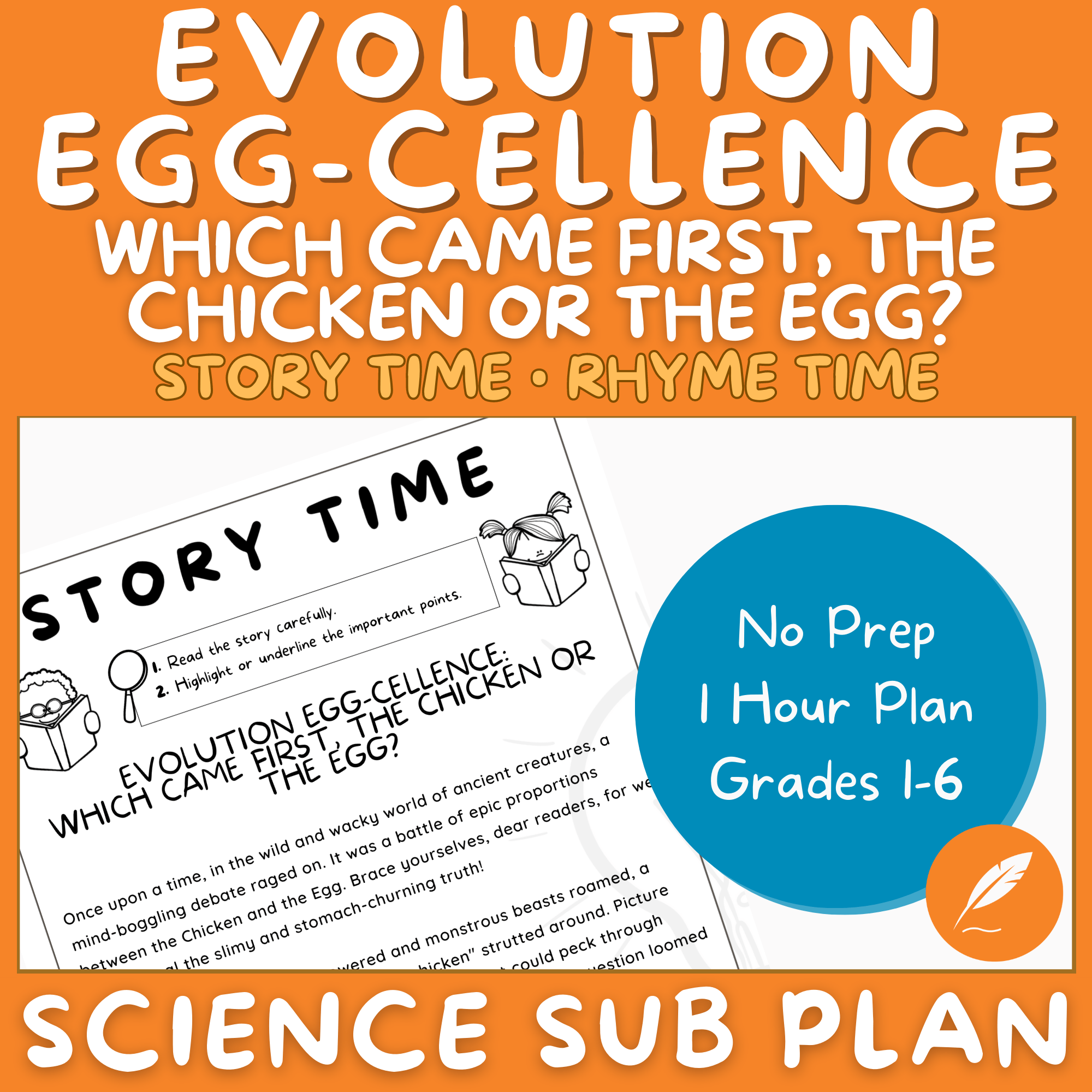
FREE Lesson Plan
Download your FREE Chicken or the Egg lesson plan!
Use this ultimate riddle to teach Grades 1-6 about evolution, genetics, and critical thinking.
Go beyond the textbook to inspire curiosity and problem-solving.
Easy-to-use no-prep resources for an engaging science class.
Get your free download from Inspirational Science For Subs today!
The Egg's Role in Animal Evolution
Now let’s focus on the second half of the riddle: the egg. Long before the chicken, the egg was already around. You're not just talking about a chicken egg here; you're talking about the amniotic egg. This structure was a massive step in animal evolution! Before the amniotic egg evolved, animals had to lay their eggs in water, just like fish and amphibians. But the amniotic egg—that hard or leathery shell holding the yolk, the protective fluids, and the developing life—changed everything. It meant animals could move away from the water and live permanently on land. That’s a game-changer for life on Earth! Dinosaurs laid eggs, reptiles lay eggs, and all birds lay eggs. So, clearly, the egg in general came first, millions of years before the first true chicken existed. This part of the great evolution puzzle is simple to explain and really drives home the idea that evolution is about huge, sweeping changes in life forms, not just minor tweaks in one species.
When Did Eggs Become Eggs?
You can tell your students that the amniotic egg first appeared with the earliest reptiles, around 300 million years ago. That's a staggering amount of time! The egg was a truly revolutionary invention of evolution. Think of it as a little portable pond. It provided a safe, moist environment where the baby could grow without drying out. This allowed creatures to spread across the whole planet. This timeline is a fantastic visual aid for showing how the simple answer to the Chicken or the Egg question—if you mean "the egg structure"—is always the egg. You can also discuss the difference between eggs laid by reptiles (often leathery) and the hard, calcified shells of bird eggs. Even the materials used have evolved! Isn’t that fascinating?
Class Question: Imagine you are one of the first reptiles to lay an amniotic egg on dry land. What dangers or problems did your new, shelled egg solve compared to laying eggs in a pond?
Solve the great evolution puzzle with your class! We break down the biology of the Chicken or the Egg to inspire critical thinking in young students. @inspirationalscienceforsubs #EdChat #TeachingScience
The Genetics of the Modern Chicken or the Egg
This is where you get to the scientific core of the Chicken or the Egg riddle. If you consider the egg specifically as one containing a creature that is genetically identical to a modern chicken, then the answer gets exciting. The first genetically modern chicken had to hatch from an egg. Why? Because the genetic changes—the mutations—that created the chicken couldn't have happened in the fully formed adult animal. Genetic changes happen in the creation of the reproductive cell, which forms the embryo inside the egg. Therefore, the last "not-quite-a-chicken" creature laid the egg, and the tiny mutation in the fertilised ovum (that's a great vocabulary word!) made the resulting chick the first of its species: the true chicken! This is a simple, yet powerful, explanation of how evolution works at the microscopic level. You’re helping your students understand heredity and mutation!
The First True Chicken
So, you see, the first chicken came from a chicken egg, but that egg was laid by a creature that wasn't quite a chicken. It's a wonderful little paradox! You can explain that this single mutation didn’t suddenly change a lizard into a chicken; it was the final small step in millions of years of change. The creature that laid that magic egg was so close to a chicken that only a geneticist would spot the difference. The real point of the great evolution puzzle isn't to pick one or the other, but to understand that they are inseparable. The egg is the mechanism for the change; the chicken is the result. This illustrates how the process of evolution is continuous and gradual, not a series of sudden, huge jumps. Trust you me, explaining it this way makes the science so much clearer for young minds!
Class Question: If the first true chicken hatched from an egg, what name would you give to the creature that laid that egg? Why?
Enjoyed the article?
Using the Riddle to Teach Evolution and Critical Thinking
The Chicken or the Egg riddle isn't just a quirky question; it's a stellar teaching tool for evolution and critical thinking skills. It pushes students past simple memorisation and into genuine problem-solving. When you present the great evolution puzzle to your students, encourage them to think about different timelines. Ask them to distinguish between the concept of an egg (the ancient amniotic structure) and the specific chicken egg. This helps them learn to define their terms, which is a key skill in science! You can turn this whole lesson into an engaging classroom debate. Have one side argue for the chicken coming first and the other side argue for the egg. They'll have to use evidence and logic to support their claims, and isn't that what science is all about?
Beyond the Textbook: Applying the Great Evolution Puzzle
You've got a fantastic opportunity here to connect this topic to other areas of science. For instance, you could link the concept of the amniotic egg to other animals that lay eggs today—turtles, snakes, platypuses! You can show them that evolution isn't just about the changes in one species, but about the success of certain structures, like the egg. This broader look at life truly inspires critical thinking. You won't have to worry about disengaged students when you use this real-world great evolution puzzle. It's instantly relatable, and it gives them the confidence to tackle huge concepts, knowing they can use logic and evidence to find an answer. You'll see how smoothly the discussion works once they realise there's a scientific answer to this ancient riddle!
Class Question: Besides chickens, what are three other living things that lay eggs, and what makes their eggs different from each other?
Chicken or the Egg: Putting it All Together for Your Class
So, you’ve broken down the great evolution puzzle! You’ve shown them that the generic egg (the amniotic egg) came first, millions of years before the chicken. And you’ve explained that the specific chicken egg came just before the specific modern chicken, because the genetic mutation that created the chicken happened inside the egg. That's a powerful narrative for explaining evolution! You’ve used the classic riddle to talk about genetics, ancient history, anatomy, and speciation. You’re truly offering innovative resources that spark creativity! You won’t have to re-explain the core ideas of evolution because the Chicken or the Egg question acts as a brilliant anchor for all the concepts. Remember, your goal is to inspire your students and ignite a love of learning in them. By tackling a problem that adults often get wrong, you’re making your young students feel clever and capable. That confidence is what truly sparks a lifelong interest in science.
That's the beauty of teaching science this way, isn't it? You take something fun and accessible and use it to teach fundamental scientific principles. You’ve given your students the tools to think critically about how life changes over time. You should feel really good about tackling this topic. You’re helping them go beyond limits and encouraging that essential spirit of exploration. I hope this content will help you save time and absolutely inspire your students! What a cracking lesson!
Class Question: If you had to explain the answer to the "Chicken or the Egg" question to a younger sibling or student, which one fact about evolution would you use to convince them?
Summary: The Ultimate Answer to the Evolution Puzzle
Well, there you have it! The definitive, scientific answer to the Chicken or the Egg question, ready for you to share with your US Grades 1-6 students. You've now got all the background you need to explain that, technically, the egg came first, if you mean the protective shell laid by early reptiles hundreds of millions of years ago. But if you’re talking about the modern chicken egg, the one that contained the first creature with true chicken DNA, then the egg still came first, just moments before the bird. This whole great evolution puzzle serves as a perfect, tangible example of the gradual nature of evolution. You've covered speciation, deep time, and basic genetics, all wrapped up in a fun riddle! It’s a wonderful way to foster critical thinking and show your students how to use evidence to solve a truly complex problem. Hopefully, you're now feeling completely prepared and inspired to lead a fantastic, in-depth discussion about life's origins. You won’t just be teaching science; you’ll be fostering that critical thinking and problem-solving that the Inspirational Science For Subs community champions!
Do you find that your students tend to lean toward the ‘chicken’ or the ‘egg’ answer when you first ask the question, and what piece of evidence do they find the most persuasive?