

You know that moment in class, that little spark in a student's eyes when a science concept suddenly clicks? That's what you live for, isn't it? Well, you’ve hit the jackpot with the story of the DNA structure. It's not just a molecule; it's a genuine human drama filled with ambition, rivalry, brilliant deduction, and maybe a tiny bit of sneakiness. It’s got all the makings of a blockbuster, and trust me, your students in grades 6-12 will be hooked. This isn't just about James Watson and Francis Crick—though they're central—it’s about the whole fierce competition to crack the genetic code and find the beautiful, elegant double helix.
At Inspirational Science For Subs, you know you’ll find those extra bits of history and context that take a lesson beyond the textbook, making it stick. Because really, understanding how the DNA structure was found—that moment when the secret of life was laid bare—is more inspiring than the structure itself. It shows students that real science isn't a neat, straight line but a fascinating, messy sprint. You’re not just teaching biology; you're inspiring future scientists, problem-solvers, and critical thinkers. Let's dig into the true story of one of the greatest scientific DNA discoveries of the 20th century.
More...
The London Scientists and the X-Ray Clues to DNA Structure
Before Watson and Crick even properly got started at Cambridge, there were folks in London doing the really hard graft. In particular, you've got to introduce your students to Rosalind Franklin. Seriously, she's the hero of this part of the story, and her contributions are often sidelined, which is a massive shame. Franklin was a formidable scientist working at King's College London, and she was an absolute ace with X-ray crystallography. Now, that’s a tough technique. It involves shooting X-rays at a crystal of a substance—in this case, DNA—and then capturing the pattern the rays make after they bounce off the atoms. It’s like trying to figure out the shape of an object only by looking at its shadow.
Franklin, along with her student Raymond Gosling, produced some incredible images. Their most famous, and perhaps most critical, photograph was dubbed "Photo 51." You can imagine the tension in that lab. Those fuzzy X-ray diffraction patterns were the clearest clues anyone had to the DNA structure at the time. The patterns practically screamed two key things: first, that the molecule had a helical, or spiral, shape, and second, that it had two repeating strands. That last bit, the two strands, was the crucial piece that led to the double helix model. She actually presented this data in a King’s College talk that Watson attended, but he clearly didn’t grasp the significance immediately—or maybe he just didn't take good notes!
Unpacking Photo 51 and the Double Helix
It was Maurice Wilkins, a colleague of Franklin’s at King's, who later showed Photo 51 to James Watson, allegedly without Franklin's direct permission or full knowledge. Now, there’s your human drama! Seeing that clear cross pattern—the distinct X shape—Watson immediately knew that the DNA structure had to be a helix. That single photograph was the tipping point. Think about that: one perfectly captured image held the secret of life, waiting for someone to correctly interpret it. It's a fantastic example of why careful data collection is everything in science. When you’re teaching this, you could ask your class: If you were in charge of the DNA research, how would you ensure that credit for every key discovery was given fairly and transparently? This helps them think critically about scientific ethics, not just the science itself.
The Cambridge Duo and the Race to Crack the Genetic Code
Over in Cambridge, you had the dynamic, slightly frantic, duo of James Watson, an American geneticist, and Francis Crick, a British physicist. They were a brilliant, restless pair who worked by building physical models—a real hands-on approach. Unlike Franklin, who was meticulously gathering experimental data, Watson and Crick were focused on theoretical model-building, trying to construct a molecule that satisfied all the known chemical and X-ray data. Their starting materials weren't DNA crystals; they were cardboard cutouts of the molecule’s chemical components: the sugars, phosphates, and the nitrogenous bases (adenine, thymine, guanine, and cytosine).
They had a few false starts. You can tell your students about their first model, which was an embarrassing failure—it had the essential parts pointing outwards, not inwards, and it was quickly dismissed by Franklin and others. It was a good reminder that even future Nobel Prize winners mess up, sometimes publicly! But they were smart, and they were desperate to be the first to solve the DNA structure. The pressure was immense. Linus Pauling, another scientific giant across the pond in the US, was also in the running, and for a while, it looked like he might beat everyone to the genetic code. That competitive element really fuels the story.
The Base Pair Breakthrough and DNA Structure
The final key to the double helix wasn’t just the X-ray data; it was a simple chemical insight that had eluded them for ages. They needed to figure out how the bases—A, T, G, and C—fit together in the middle. The answer came from a lesser-known scientist, Erwin Chargaff, who had established that the amount of Adenine (A) always equalled the amount of Thymine (T), and the amount of Guanine (G) always equalled the amount of Cytosine (C). This is called Chargaff's rules. Once Watson saw a diagram showing how an A could pair perfectly with a T, and a G could pair perfectly with a C—like puzzle pieces that fit just so—everything snapped into place. They finally had the correct arrangement for the DNA structure. The two strands of the helix were held together by these complementary base pairs. Talk about an 'Aha!' moment! What's neat is how the DNA discovery was built on the essential work of so many different people, not just the two who got the biggest credit.
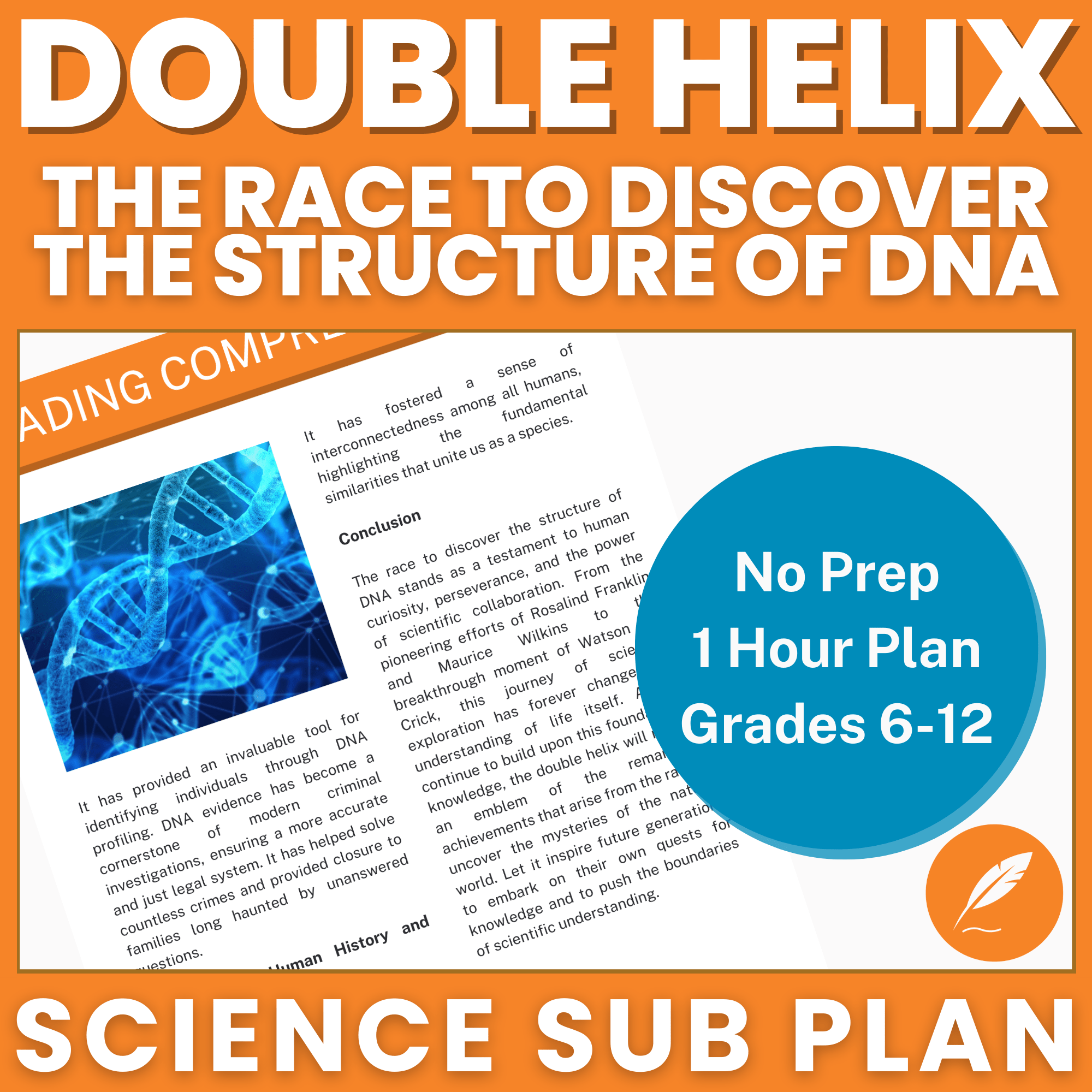
FREE Lesson Plan
Get an engaging, high-school ready resource focusing on the fierce race to solve the DNA structure, including Rosalind Franklin's vital role.
Inspire critical thinking using the true story of the double helix and the genetic code.
Perfect for US grades 6-12.
Save time planning your next big biology unit!
The Elegant Simplicity of the Double Helix
Once you see the final model of the double helix, it’s just stunningly simple and elegant. It looks like a twisted ladder, doesn't it? The sides of the ladder are made of alternating sugar and phosphate molecules—that’s the 'backbone' of the DNA structure. The rungs of the ladder are those paired nitrogenous bases (A-T, G-C) held together by hydrogen bonds. That simple, beautiful twist is what gives the molecule its stability and, crucially, allows it to replicate. This structure immediately suggested how heredity worked. It wasn't just a structure; it was the molecular mechanism for passing on the genetic code.
Watson and Crick didn’t just find the DNA structure; they essentially predicted how life reproduces itself. The two strands of the double helix can 'unzip,' and then each old strand acts as a template to build a brand new complementary strand, ensuring an exact copy of the genetic code is made every time. This self-copying ability is arguably the most brilliant aspect of the DNA discovery. It showed science how traits are passed down and explained why children look like their parents. This ability to replicate is why DNA is the master molecule of life. It’s hard to imagine a more perfect, self-contained system.
The Lasting Impact of the DNA Discovery
This find wasn't just a win for chemistry or biology; it truly was the birth of modern molecular biology. Suddenly, you could explain diseases, genetic inheritance, and even evolution at the deepest, most fundamental level. The race to crack the genetic code wasn't just about fame; it literally changed the course of science. Think of all the breakthroughs that have happened since 1953: genetic engineering, sequencing the human genome, gene therapies. None of it would be possible without knowing the precise DNA structure. It's a powerful lesson for your students that a basic scientific DNA discovery can have ripple effects for generations. You could pose this question: If you could use genetic engineering to solve one major global problem (like hunger or disease), what would you tackle first, and why?
Ditch the boring textbook! Teach the true story of the double helix race, the genetic code, and Rosalind Franklin's vital Photo 51. Your students will be hooked! @inspirationalscienceforsubs #ScienceTeacher #DNAStructure #Biology
Bringing the True Story of the Double Helix to Your Classroom
This story is full of teachable moments that go way beyond the four bases. It’s a perfect example of how science requires collaboration and competition, how theoretical work needs to be grounded in solid data, and how important it is to respect the work of all scientists. When you present the DNA structure in class, don't just show the model; talk about the people behind it. Get your students invested in the characters and the high-stakes pressure. Use the timeline—how it all came together in those few frantic months in 1953—to show how fast things move when brilliant minds focus on a single question.
You can really inspire your students by focusing on Rosalind Franklin’s tenacity and skill. She laid the essential groundwork for the DNA discovery, but sadly, she passed away before the Nobel Prize was awarded (it’s not given posthumously), and her vital role was often downplayed early on. Highlighting her contribution is a fantastic way to discuss equality and recognition in science, which is a great talking point for your students in those critical thinking moments. It helps them see that science history is complex, and sometimes you have to look deeper to find the full true story.
Teaching the Structure and the Code
When teaching the double helix itself, use analogies. The sugar-phosphate backbone is like the rope in a twisted swing, and the bases are the slats you stand on. This helps simplify the complex chemistry of the genetic code. You might even have them build their own models using pipe cleaners or Lego to really cement that understanding of the complementary base pairing—the A-T and G-C rule. That hands-on experience is always a winner. You want them to look at the DNA structure and not just see a diagram, but see the mechanism for life itself. This amazing DNA discovery is a cornerstone of modern biology. Try asking your class: If you had to design a code for all life on Earth using only two 'letters' instead of four (A, T, G, C), how would you structure the new double helix to store the same amount of information?
Enjoyed the article?
Summary: The Enduring Legacy of the DNA Discovery
The race to solve the DNA structure remains one of science’s most compelling tales. It wasn't just a moment of genius from Watson and Crick, but the culmination of dedicated work from multiple scientists, particularly Rosalind Franklin, whose X-ray data was the pivotal clue. This DNA discovery gave us the beautiful, functional model of the double helix, instantly explaining how genetic information is stored, copied, and passed down through the genetic code. It’s the ultimate lesson in collaboration, competition, and the power of interpreting evidence correctly.
We hope this deep dive into the true story will help you save time and inspire your students with the sheer drama of scientific history. Showing them that the double helix was found through a mix of careful experimentation, clever deduction, and good old-fashioned rivalry will truly ignite their love of learning. It’s a powerful story about science being done by real, flawed, ambitious people. What’s your favourite lesser-known fact about the DNA structure that you’re going to use to grab your students’ attention this week?