

Right, let’s talk about something truly fascinating: the Electromagnetic Spectrum. You might hear 'spectrum' and think of a rainbow—and you wouldn't be wrong, exactly! Visible light is certainly a part of it, but it's just a tiny slice of a much bigger, much wilder pie. Honestly, it's one of those topics that can really make your students sit up and take notice because it’s not just textbook stuff; it’s happening right now, all around them.
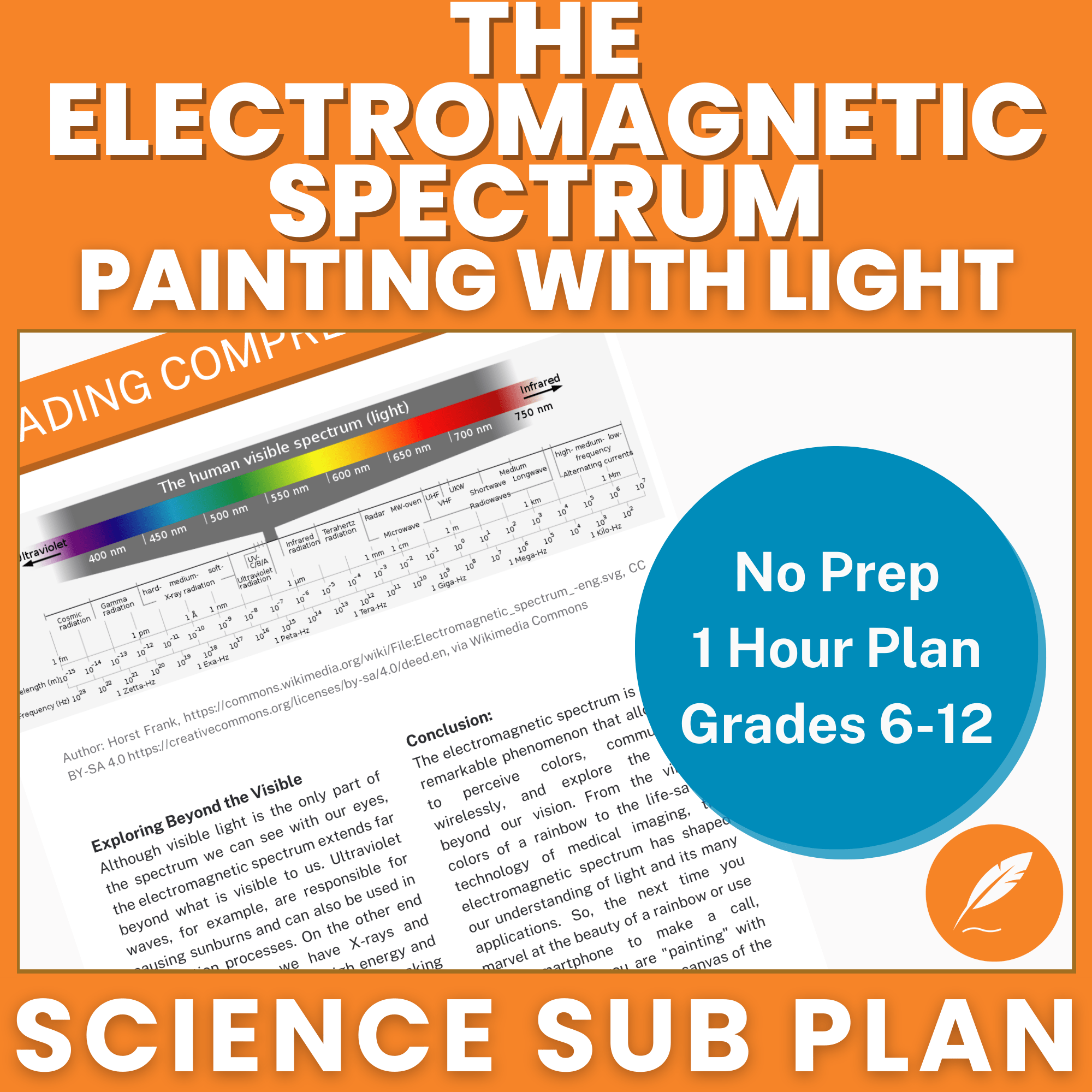
The Electromagnetic Spectrum includes all the different kinds of light and energy that travel as waves. You've got radio waves carrying your favourite tunes, microwaves heating up your leftovers, and X-rays giving doctors a peek inside the human body. Isn't that incredible? Everything from the warmth of the sun on your skin to the signal on your mobile phone is powered by these invisible (mostly!) electromagnetic waves. As you’re preparing lessons, you’re probably looking for innovative resources to spark creativity and ignite a love of learning. Well, understanding the complete Electromagnetic Spectrum is the key that unlocks so much of modern science and technology. We hope this content will help you save time and inspire your students!
More...
All the Invisible Light: Introducing Electromagnetic Waves
You know how when you throw a pebble into a pond, you get ripples? That's kind of what’s going on with electromagnetic waves. But instead of water, you've got vibrating electric and magnetic fields doing the work—hence the name! These waves don't need a medium like air or water to travel, which is pretty handy because it means the sun's energy can zoom through the vacuum of space right to our planet. Think about that for a second. That's a huge concept!
It's all about energy. The thing that separates one type of Electromagnetic Spectrum wave from another is its wavelength and frequency. Imagine a huge, long skipping rope. If you swing it slowly, you get long, lazy waves—that's like a radio wave, low frequency, low energy. Now, give that rope a quick, sharp shake, and you get lots of tight, short wiggles—that's more like a gamma ray, high frequency, high energy. The entire Electromagnetic Spectrum is just a continuous scale showing all these different vibrations. It starts with the long, slow-moving waves and ends with the short, ultra-fast ones. Getting students to visualise the differences between long and short wavelength is a great way to start building their foundational knowledge. You can't see most of them, but you use them constantly.
Getting Technical: Wavelength and Frequency
Let's quickly get down to brass tacks. Wavelength is the distance between one peak of a wave and the next peak. Simple as that! Frequency is how many of those waves pass a certain point in one second. It's measured in Hertz (Hz). A lower frequency means a longer wavelength, and a higher frequency means a shorter wavelength. It’s an inverse relationship, and getting that clear is vital for really understanding the Electromagnetic Spectrum. For example, those huge radio waves might have a wavelength measured in kilometres! Conversely, the wavelength of an X-ray is about the size of an atom. Seriously!
Question for the class: If you could only see one type of Electromagnetic Spectrum wave (besides visible light) for one whole day, which type would you choose, and why? What cool things do you think you’d be able to "see"?
The Radio Wave, Microwave, and Infrared Sections
Moving along the Electromagnetic Spectrum, you first bump into the big, broad waves that carry a lot of our communication. These are the waves you'll want to focus on when you’re discussing how modern technology works—it's incredibly relatable for students!
Radio Waves: The Communication Backbone
Did you know that radio waves are the longest waves in the Electromagnetic Spectrum? They can be miles long! They’re the workhorses of broadcasting and communication. Your car radio, TV signals, even some cordless phones and baby monitors use them. Because their wavelength is so long, they can travel huge distances and even pass through buildings and mountains without too much trouble. That's why you can still listen to a radio station when you're driving through a tunnel—mostly! It's a fantastic example of physics having real-world utility. When you talk about radio waves, you’re talking about the infrastructure of the information age.
Microwaves: Heating and Tracking
Next up, getting a little shorter, you've got microwaves. Everyone thinks of zapping a meal in the kitchen, but they do so much more than just that! Microwaves are crucial for global communication, being used by satellites to send information around the planet. And, of course, they are key to GPS and radar systems. When an air traffic controller is tracking a plane, they’re using microwaves! It's an excellent point for demonstrating how specific wavelength properties lend themselves to specific tasks. The shorter wavelength compared to radio waves means they can carry more focused information.
Infrared Radiation: Heat You Can Feel
As we move toward the middle of the Electromagnetic Spectrum, we find infrared radiation. This is essentially heat! You can’t see it, but you certainly feel it. When you stand near a warm campfire or a radiator, you’re experiencing the effects of infrared radiation. Night-vision goggles and thermal cameras rely on this radiation to show objects based on their heat signature. Teaching this section is a brilliant opportunity to link energy transfer principles with everyday observation. The light you can see from a heat lamp? That’s only a small fraction of the infrared radiation it’s emitting. Most of it is invisible but definitely noticeable!
Question for the class: If all forms of radio waves and microwaves suddenly stopped working for one hour, what would be the biggest disruption to your day? What would you suddenly not be able to do?
FREE Lesson Plan
This engaging, human-like guide includes teacher notes and compelling class questions on radio waves, visible light, frequency, and X-rays. Help your students move Beyond the Textbook, Beyond Limits by connecting abstract physics to everyday life. Perfect for middle and high school science teachers looking for innovative resources. Download now and inspire curiosity!
The Visible Light Slice of the Electromagnetic Spectrum
Now, this is the part of the Electromagnetic Spectrum that everyone knows! Visible light is the tiny fraction of the whole spectrum that your eyes are able to detect. Isn't it crazy that the light we see, which seems to define our world, is such an incredibly small part of the total picture?
What Makes Visible Light Special?
The wavelength of visible light is just right—not too long, not too short—to interact with the receptors in your eyes, called rods and cones. When white light passes through a prism or water droplets (hello, rainbow!), it splits into its component colours: Red, Orange, Yellow, Green, Blue, Indigo, and Violet. We remember this sequence as the famous ROYGBIV! Red light has the longest wavelength in this visible section, and Violet has the shortest. Think of a sunset; the red and orange colours travel through the atmosphere more easily than the blue, which is scattered away. This is another fantastic connection point for physics and real-world observation. Getting a true handle on the Electromagnetic Spectrum means understanding the boundaries of our own perception.
The specific wavelengths in the Visible Light section range from about 700 nanometres (nm) for red light down to about 400 nm for violet light. A nanometre is a billionth of a metre! That tells you just how tiny these waves are compared to the kilometre-long radio waves! It’s all about scale and getting students to appreciate that massive difference in wave properties across the Electromagnetic Spectrum.
Connecting Colour to Frequency
The colour you see is determined by the light's frequency. High-frequency visible light appears violet or blue, while low-frequency visible light appears red. When you look at a green leaf, the leaf is absorbing all the other colours of visible light but reflecting the green frequency back to your eye. That’s why it’s green! It’s not magic; it’s just the Electromagnetic Spectrum in action. This is the perfect section to inspire your students by showing them that something as simple as the colour of their clothes is dictated by physics!
Question for the class: If your eyes could see the entire Electromagnetic Spectrum, how would the world look? What problems or benefits might that ability present for you?
Why is the sky blue? It's all about frequency and wavelength in the Visible Light section of the Electromagnetic Spectrum! Get fun facts and teaching tips @inspirationalscienceforsubs #HighSchoolScience #PhysicsFun
UV, X-ray, and Gamma Ray: The Powerful End of the Spectrum
Moving past visible light, we enter the high-energy, short-wavelength part of the Electromagnetic Spectrum. This is where the waves start to get a bit more powerful and, frankly, a bit more dangerous if not handled properly!
Ultraviolet (UV) Radiation: Sunburn and Sterilisation
You probably know UV radiation best from sun exposure. It’s what gives you a nice tan—and, unfortunately, a nasty sunburn if you’re not careful! UV radiation has enough energy to cause chemical reactions. That's why it's used for sterilisation (it kills bacteria) and why it helps your body produce Vitamin D. But remember, the shorter the wavelength in the Electromagnetic Spectrum, the higher the energy, which means more potential for damage to living cells. That’s a key safety lesson to pass on to students.
X-rays: Seeing Through Skin
Now we’re talking about some serious energy! X-rays have such short wavelengths that they can pass right through soft tissues like skin and muscle, but they're stopped by denser materials like bone. This property makes them absolutely invaluable for medical imaging. The development of X-ray technology was a massive leap forward, allowing doctors to look inside the body without surgery. It's a wonderful topic for combining science with history and even ethics. Again, this is a part of the Electromagnetic Spectrum that requires caution, as prolonged exposure can be harmful due to the high energy of these waves.
Gamma Rays: The Shortest and Strongest
Finally, at the absolute high-energy end of the Electromagnetic Spectrum, you’ve got gamma rays. These have the shortest wavelengths and the highest frequencies. They pack an enormous punch! They’re created by nuclear reactions and radioactive decay, and while they can be used to treat cancer (radiotherapy), they are incredibly dangerous. They can easily penetrate most materials, even thick concrete. The study of gamma rays coming from space gives astronomers a look at some of the most violent and energetic events in the universe, like supernovae and black holes. The sheer power contained in a single gamma ray is mind-boggling, and it really drives home the vast range of the complete Electromagnetic Spectrum.
Question for the class: Scientists use gamma rays to study black holes and other intense cosmic events. If you were an astronomer, how would you design a spacecraft or observatory to safely capture and analyse these powerful waves?
Enjoyed the article?
The Importance of Understanding the Electromagnetic Spectrum
Why is the Electromagnetic Spectrum such a crucial concept for your students to grasp? Because it underpins almost everything in the modern world. It’s not just abstract physics; it's the working mechanism for their phones, the satellite TV they watch, the medical scans their grandparents might need, and the reason the sky is blue. Understanding the different wavelengths and frequencies isn't just about memorising terms; it’s about critical thinking and problem-solving.
Electromagnetic Spectrum Applications
Think about all the devices that rely on different parts of the Electromagnetic Spectrum:
- Radio waves: Used for Wi-Fi, AM/FM radio, and cell phone calls.
- Microwaves: Essential for radar and satellite communication.
- Infrared: The basis for remote controls and thermal imaging cameras.
- Visible Light: Used in fibre optics for high-speed internet transmission.
- X-rays: Used in airport security scanners and medical diagnostics.
When you present these real-world uses, you're not just giving a lesson; you're offering innovative resources that spark genuine curiosity. You’re helping them move Beyond the Textbook, Beyond Limits, by showing them that science is everywhere. Trust me, linking the abstract physics of a wave's wavelength to the concrete reality of streaming a video or getting an X-ray makes a big difference to student engagement. You won't have to waste time re-explaining the same thing if they can truly relate to the concept!
Question for the class: Imagine you're an inventor. Which part of the Electromagnetic Spectrum would you use to create a brand-new communication device, and what would its unique advantage be based on the wave's properties?
Wrapping Up The Waves That Connect Us All
Well, there you have it—a trip across the fantastic and far-reaching Electromagnetic Spectrum! Hopefully, you're now buzzing with great ideas on how to present this topic in a more engaging, relatable way for your students. From the gigantic radio waves that keep us connected to the minuscule, high-powered gamma rays from space, it's clear that energy moves around the cosmos in ways we're only just beginning to fully appreciate.
Remember, teaching the Electromagnetic Spectrum is about more than just listing the parts; it’s about showing the relationship between wavelength, frequency, and energy. It's about inspiring those moments of "Aha!" when a student realises the wave that cooks their popcorn is just a slightly shorter version of the wave that carries their music. That connection fuels their exploration and critical thinking. Go and show them how the world is illuminated by this incredible, invisible spectrum! You've got this.
Do you think focusing on the real-world applications of infrared radiation (like thermal imaging) or the high-energy properties of X-rays makes the Electromagnetic Spectrum feel more relevant to today's students? Which section do you think they’ll find the most surprising?