

Ever noticed how summer in the US just doesn't do "gentle" anymore? You've got everything from sizzling sun that makes the playground sizzle to dramatic skies that dump inches of rain in an hour. It's a goldmine of real-world science waiting to inspire your students. This blog post is absolutely packed with fun, facts, and the simple 'how' and 'why' behind summer's most powerful events. Forget those dusty textbooks; you'll find easy-to-explain concepts about extreme weather—things like heatwaves, floods, and terrifying wind storms—that your class will genuinely love. You want to spark that critical thinking and a love of learning? Understanding something as massive as extreme weather is the perfect way. You can help your students connect what they see out the window to the amazing physical science happening high above them. You’ll be saving time and getting those 'oohs' and 'aahs' you want in the classroom!
More...
How a Heatwave Makes Your Lunchbox Melt
Ever feel like the air outside is wearing a blanket? That’s what a heatwave is all about! It’s a period of unusually hot weather that sticks around for several days. In the US, extreme heat is actually one of the most dangerous weather types. But what causes it? Well, you're looking for something called a "high-pressure system." Think of air pressure like a giant hand pushing down on the ground. A high-pressure system is a huge area of sinking air. When air sinks, it gets squished, and when it gets squished, it heats up—it’s just basic physics! This sinking air is also really dry, which means it doesn't form clouds. Clouds usually act like a giant umbrella, blocking some of the sun's energy, but without them, the sun just bakes the ground all day long. This keeps the temperatures incredibly high for days on end, leading to extreme heat. Another part of this puzzle is humidity, especially in the eastern US. That sticky feeling? That's water vapour in the air. When the air is full of water, your sweat can't evaporate easily, and that's how your body cools down. So, a heatwave with high humidity feels much, much hotter. The combination of intense solar radiation, high pressure, and high humidity is the recipe for serious extreme weather. What's more, these extreme heat events can lead to droughts, where the land dries out, and that's a whole other science lesson in itself!
The Simple Science of Extreme Heat
It’s all about trapped energy. The atmosphere acts a bit like a greenhouse, keeping heat in. During a heatwave, that "greenhouse" is working overtime. You can talk to your class about how the ground absorbs the sun's energy, heats up, and then radiates that heat back into the lowest layer of the atmosphere. Because the high-pressure system is pushing down, it keeps that hot air from rising and moving away. It's like putting a lid on a pot of boiling water—the heat just builds and builds. Isn't that simple yet fascinating?
Class Question: If you could invent a new, safe material to paint roads and roofs that would reflect the sun's heat back into space, what colour and texture would you choose, and why would your choice help stop a heatwave?
The Explosive Power of Thunderstorm Science
Everyone loves a good summer thunderstorm, right? That dramatic lightning and the booming thunder are certainly exciting. But what’s going on up there? You're seeing one of nature's most efficient engines for moving heat and energy. It all starts with warm, moist air rising—that’s called convection. Think of a giant bubble of air lifting up off the hot ground. As this warm, moist air rises, it hits cooler air higher up, and the water vapour in it condenses, making those towering cumulonimbus clouds. It's a constant cycle of hot air going up and cool air sinking down, which creates strong updrafts and downdrafts.
How Lightning and Thunder Start
The real drama starts inside the cloud. All those tiny ice particles and water droplets are crashing into each other as they move around in the powerful updrafts and downdrafts. This friction, believe it or not, builds up a massive electrical charge! It’s just like rubbing a balloon on your hair. Eventually, the charge is so massive that the cloud has to release it, and that's lightning—a gigantic spark that heats the air around it to over 27,000°C! That super-heated air expands faster than the speed of sound, creating a shockwave. And what do you hear when that shockwave reaches your ears? That's right: thunderstorm science in action! The noise is simply air molecules rushing back together after the lightning flash. The difference in time between seeing the flash and hearing the boom tells you how far away the extreme weather is.
Class Question: If you were an air particle inside a giant thunderstorm cloud, describe what your "day" would be like, from the moment you leave the ground to the moment you fall as a raindrop.
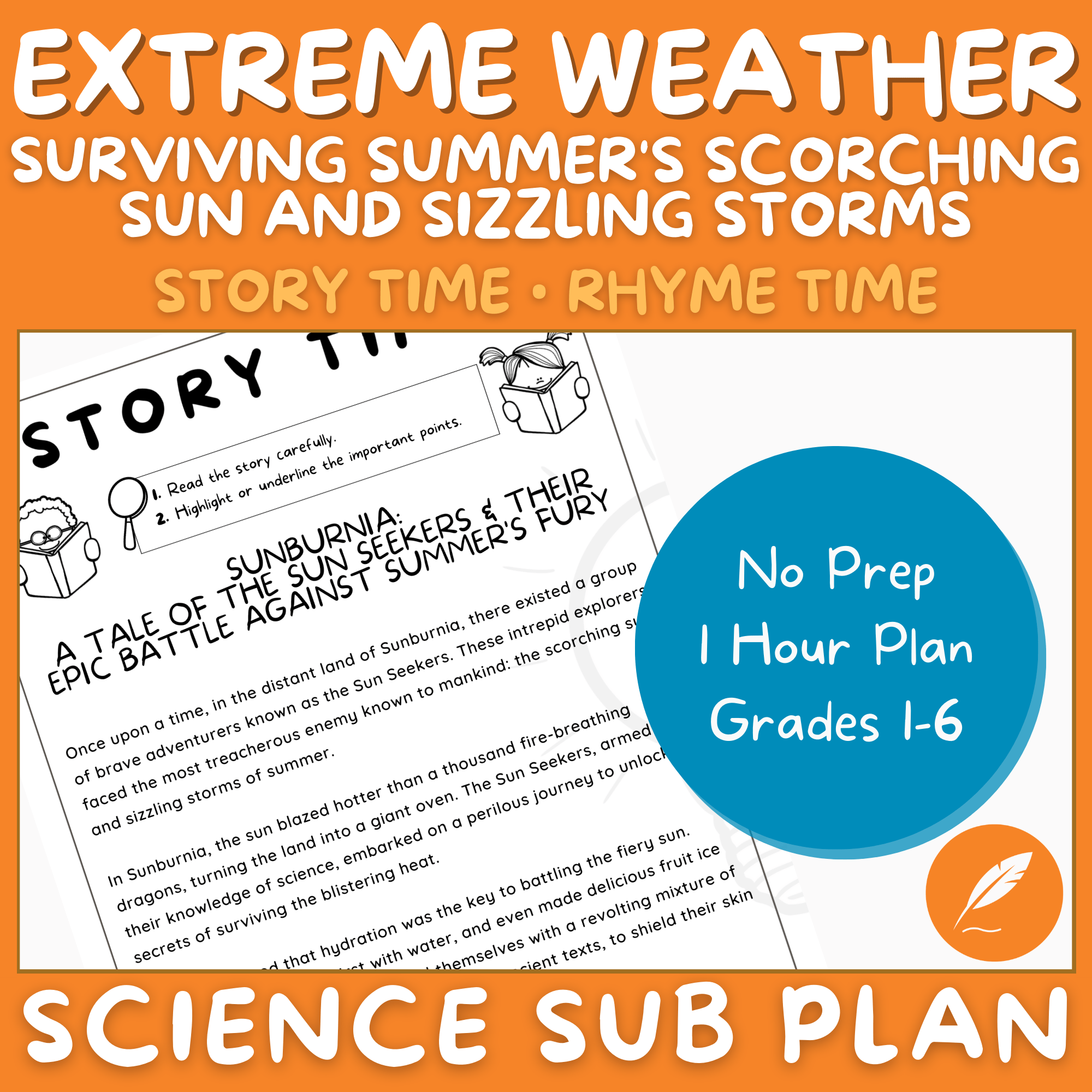
FREE Lesson Plan
Transform your primary science lessons! This FREE lesson plan helps you teach the physics behind extreme weather, like how hurricanes spin and why a heatwave makes us sticky. Packed with activities for Grades 1–6 that spark critical thinking and solve the puzzle of summer storms. Get simple, easy-to-teach facts on Flash Floods, Thunderstorm Science, and more.
Go Beyond the Textbook today!
Flash Floods: When the Sky Opens Up
Sometimes, it’s not the heat that's the problem; it’s the water! A flash flood is one of the scariest and fastest-moving types of extreme weather. It can turn a dry stream bed into a raging river in minutes. The key factor here is speed and amount. You don't get a flash flood from a gentle all-day drizzle. You get it from a torrential downpour, usually caused by a slow-moving, powerful thunderstorm or a tropical storm system.
Understanding Too Much Rain
It comes down to simple capacity. The ground can only absorb water so quickly. If rain falls faster than the soil can soak it up—say, 10 centimetres in an hour—all that extra water has to go somewhere. It runs off the streets, down hills, and into the nearest low-lying area, like a stream, river, or street drain. When the amount of water coming in is greater than the capacity of the stream or river to hold it, the water jumps the banks—that's a flash flood. In urban areas, it’s even worse! Pavement and concrete are non-porous surfaces; they can’t absorb a single drop. All the rain that hits a road or a roof immediately becomes runoff, making the flooding much more severe and immediate. This type of extreme weather shows your students exactly how the water cycle interacts with the land around them.
Class Question: Imagine your school playground suddenly became non-porous (like solid rock) and then it rained heavily. Where would the water flow first, and what would your class need to do to stop a miniature flash flood from happening?
Why are summer storms so wild? Break down the Tornado Science and Hurricane Science for your KS2 class! Simple facts for big concepts. @inspirationalscienceforsubs #scichat #STEM #scienceeducation #ScienceFacts
Why Hurricanes and Tornadoes Are the Ultimate Extreme Weather
Now, let's talk about the big wind machines! The US gets two of the most powerful rotating storms on the planet: hurricanes and tornadoes. While they both spin, they are created in totally different ways and locations. A hurricane is a massive, low-pressure system that forms over warm ocean water. It needs water that is at least 26.5°C (80°F) to fuel itself. The low pressure creates a huge upward flow of air that pulls in surrounding air, causing the whole thing to spin due to the Earth's rotation. These storms can be hundreds of miles wide and last for weeks, bringing devastating wind and rain. The science behind them is a beautiful (and terrifying!) demonstration of thermodynamics.
Tornado Science vs. Hurricane Science
A tornado, on the other hand, is born over land, usually from one of those big supercell thunderstorms you talked about earlier. It's a much smaller, extremely intense column of spinning air. It all starts with wind shear—when wind speeds and directions change drastically at different altitudes. This shearing creates an invisible, rotating tube of air. If that rotation gets tilted vertically by a strong updraft in a thunderstorm, you get a funnel cloud, which can eventually become a tornado. They are much smaller than a hurricane, only lasting minutes, but the wind speeds are far greater! You can help your students compare and contrast these two terrifying examples of extreme weather. One is fuelled by the ocean and lasts forever; the other is fuelled by a thunderstorm and is here and gone in a flash.
Class Question: If you had to safely study a hurricane and a tornado using only scientific instruments, which one do you think would be easier to measure without getting too close, and why?

Enjoyed the article?
Your Class is Ready for a Weather Power-Up!
You've now got a fantastic toolkit of facts to inspire your young scientists! This blog post has covered the essential science behind summer’s most powerful extreme weather events, from the simple physics of a scorching heatwave to the complex rotation that makes a devastating hurricane or a fast-moving flash flood. Understanding these powerful forces isn't just about meteorology; it's about connecting classroom learning to the real world outside the window, fostering curiosity, and building critical thinking skills. That's the core mission of Inspirational Science For Subs: to go beyond the textbook and ignite a love of limitless learning. You'll find that explaining things like the sinking air in a heatwave or the friction that builds lightning in a thunderstorm is incredibly effective for engaging young minds. This content is ready for you to share and adapt!
Do you think your students would be more interested in the raw power of tornado science or the steady build-up of a flash flood? Let your thoughts be known in the comments below!