

Welcome back to Inspirational Science For Subs! You're probably always looking for that one amazing topic that stops the class chatter and genuinely sparks that 'wow' moment, aren't you? Well, you're in for a treat today. Forget flat geometry and say hello to the wild, messy, beautiful truth of the world around us. Have you ever really looked at a cauliflower, or a fern, or even the crack running across a pavement? They all share a secret, a fundamental design principle that shapes our entire planet: fractals. These aren't just cool patterns; they are Nature's Blueprint, the mathematical backbone of everything from your lungs to the distribution of galaxies. It’s the ultimate lesson in self-similarity, showing us that the small part perfectly mirrors the whole. You can use this incredible concept to light up student creativity, encourage critical thinking, and show them that maths and science are deeply woven into the fabric of reality. That’s why you're here, after all—to go Beyond the Textbook, Beyond Limits, and inspire that next generation of problem-solvers. This content should certainly help you save time and inspire your students!
More...
What Exactly Are Fractals, Anyway?
You might hear the term fractals and think of complex, confusing computer-generated images, but honestly, it’s much simpler—and much more beautiful—than that. A fractal is essentially a never-ending pattern. It's an object or shape that looks the same no matter how closely you zoom in on it. Think of it like a repeating loop of design. You know how you can take a small piece of a fern leaf, and that tiny piece looks exactly like the entire branch, only smaller? That's self-similarity in action. You can keep zooming in, and the same intricate pattern keeps repeating itself, infinitely, at every scale. That’s what defines a fractal. It’s this remarkable property that lets nature pack massive complexity into small spaces.
The Brilliant Simplicity of Self-Similarity
The real power of fractals lies in this idea of self-similarity. Imagine a tiny branch coming off a large tree limb. Now look closer at that tiny branch; it has even tinier twigs coming off it. If you compare the structure of the smallest twig to the structure of the entire huge branch, you’ll find they follow the same basic design rule. It’s like a miniature version of the whole thing. You see this everywhere: in coastlines, where the small inlets and bays look structurally similar to the large geographical curves; in lightning bolts, where the smaller sparks mirror the main bolt’s path; and incredibly, in the way your blood vessels branch out. It’s an efficient design, isn’t it? It allows the blood supply to reach every single cell in your body, just like the branches ensure every leaf gets sunlight.
- Definition: A rough or fragmented geometric shape that can be split into parts, each of which is (at least approximately) a reduced-size copy of the whole.
- Key Idea: Self-similarity across different scales.
- Real-World Example: The structure of a Romanesco broccoli, which is perhaps the most visually stunning example of a natural fractal.
Wouldn’t it be fun to ask your class: If you were designing a giant, fictional alien creature and needed to get nutrients to every single part of its body, what kind of system would you design based on the idea of fractals?
Nature's Blueprint: How Fractals Shape Our World
The concept of a fractal isn't just an abstract mathematical trick; it's a practical, real-world design solution. When you start looking, you realise that the entire planet is built using fractals as its core framework. Why? Because this pattern is the most efficient way to maximise surface area. Think about your lungs. Their job is to transfer oxygen into your blood, right? To do that effectively, they need a huge surface area for gas exchange. If your lungs were just simple, smooth bags, you'd only get a tiny fraction of the oxygen you need. Instead, they use a complex, tree-like, branching fractal structure—the bronchi and bronchioles—which maximises that crucial surface area, allowing you to breathe normally.
The Mighty Math Behind Natural Shapes
The natural world has to deal with limitations—like having to move fluid through a limited space (blood), capturing energy (leaves), or dissipating energy (lightning). The fractal pattern is the best way to solve these problem-solving challenges. Take the river systems that drain huge landmasses. The small streams feed into larger creeks, which feed into major rivers, and the entire system follows a repeating, branching design—a geological fractal. This isn't a coincidence; it’s physics finding the most effective pathway to move water across a varied landscape. The concept of self-similarity explains why a small tributary looks like a miniature version of the main river basin. It's all about optimal flow and coverage.
- Lungs: Optimised for gas exchange (high surface area).
- Trees: Optimised for collecting sunlight and transporting water.
- Coastlines: The length is effectively infinite because the pattern of inlets and peninsulas repeats at smaller and smaller scales.
Ask your class this: If you had to use the concept of self-similarity to redesign the pipes in your home to make the water flow faster and more evenly, how would you change the pipe layout?
FREE Lesson Plan
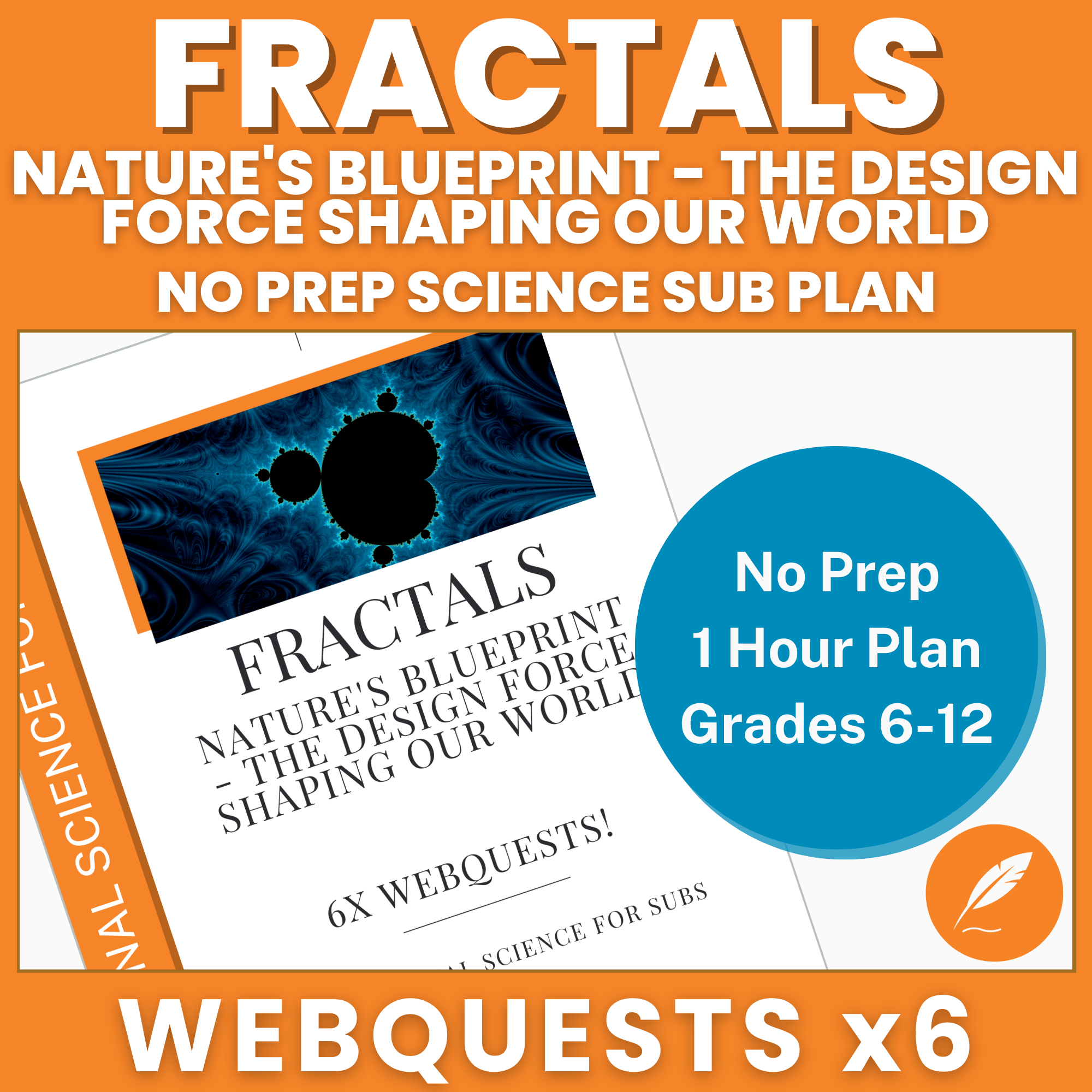
Grab this FREE fractals lesson plan conatining 6 amazing WebQuests!
Go Beyond the Textbook to inspire critical thinking and problem-solving using real-world examples of self-similarity (like trees, lungs, and the Koch Snowflake).
Perfect for Grades 6-12 science and maths teachers looking for engaging, hands-on activities.
Fractals in the Digital Age and Beyond
It’s easy to think of fractals as purely a science or maths topic, but you'll find them popping up in the most unexpected places—especially in technology and art. Have you ever wondered how Hollywood makes those incredibly realistic-looking computer-generated landscapes, like mountain ranges, stormy seas, or alien terrain? They use fractal algorithms! Because a computer can quickly generate a pattern that exhibits self-similarity, the programmers can generate an entire mountain range by simply repeating the same basic shape at different scales, making the terrain look totally natural and complex without having to manually draw every single rock and peak. This clever application of fractals saves countless hours of work.
Applications of Self-Similarity in Technology
Beyond cool graphics, the concept of self-similarity in fractals is making a difference in fields you might not expect. Electrical engineers use fractal patterns to design antennas for mobile phones. A traditional antenna needs to be a certain length to pick up a certain frequency, making them bulky. But by folding the antenna’s metal path into a repeating fractal shape, you can pack a much longer path into a tiny space. This means your phone can receive a wider range of signals while staying slim. Similarly, medical imaging uses fractal analysis to study the complexity of human tissue and even diagnose certain diseases based on how the patterns in cells deviate from healthy self-similarity. It’s amazing how this one mathematical idea has so many practical problem-solving applications.
- Computer Graphics: Creating realistic textures, clouds, mountains, and shorelines.
- Antenna Design: Fractal antennas are compact and multi-band.
- Medical Science: Analysing irregular patterns in tumour growth or blood vessel damage.
Try this question with your students: If you wanted to create a fictional energy collection device for a spaceship that needed to be as small as possible but gather the most energy, how would you incorporate the principle of self-similarity into its design?
Fractals are Nature's Blueprint! Use the concept of self-similarity to spark exploration and problem-solving in your classroom. Find simple, engaging activities here! @inspirationalscienceforsubs #HighSchoolScience #ScienceRocks #ProblemSolving
A Simple Start to Teaching Fractals
Bringing the idea of fractals and self-similarity into your science or maths classroom isn't difficult; in fact, it’s one of the most engaging concepts you can introduce! You don’t need high-tech equipment, just a willingness to look closely at the world. Start by simply having your class bring in photos of natural objects they think show a repeating pattern. You’ll be stunned by the examples they find, from trees outside the school to patterns in a slice of pineapple. You could also explore famous mathematical fractals, like the Koch Snowflake or the Sierpinski Gasket. These examples are fantastic for illustrating how you generate an infinite pattern from a simple set of rules—the essence of a fractal.
Beyond Geometry: The Magic of Repeating Rules
The important lesson here for critical thinking and problem-solving isn’t just about the shapes; it’s about the rule that creates them. A fractal is simply the result of repeating a process over and over. Take the Sierpinski Gasket: you start with a triangle, connect the midpoints of the sides to form a new, inverted triangle, and then remove the inverted triangle. You then repeat the process on the three smaller remaining triangles. The key is the repetition of the rule. This is a brilliant tie-in for computer science or algorithmic thinking, showing students that complex results often come from simple, iterative steps. Trust me, getting them to draw out a few iterations of a fractal is a brilliant way to keep them engaged!
- Hands-on Activities: Drawing the first few steps of the Sierpinski Gasket.
- Nature Walk: Identifying five examples of self-similarity in the local environment.
- Maths Tie-in: Calculating the area or perimeter of a fractal as the iterations increase.
Here’s a great challenge for the class: The perimeter of a Koch Snowflake technically approaches infinity, even though its area stays finite. How is that possible, and what does it tell you about measuring rough objects in the real world?
Enjoyed the article?
Summary: A Limitless Learning Journey
So there you have it—a peek into the amazing world of fractals, Nature's Blueprint for building our planet. You've seen how this one powerful idea, self-similarity, explains the branching of trees, the structure of your lungs, the design of river systems, and even the graphics in modern films. It’s a concept that beautifully marries maths and science, making it a perfect tool for sparking student exploration, critical thinking, and problem-solving right across the curriculum. By introducing fractals to your students, you're not just teaching a topic; you’re giving them a new lens through which to view their entire world, showing them that complexity and beauty often arise from simple, repeating rules. You're helping them go Beyond the Textbook, Beyond Limits. Which of the natural fractals—the cauliflower, the tree, or the coastlines—do you think your students will find most inspiring? Leave a comment below and share your best fractal activities!