

You know the name Galileo Galilei. You know he looked at the stars, and you probably know he got into a bit of trouble doing it! But let's be honest, teaching the history of science can sometimes feel… well, a little dusty. You want to connect with your students—those US 6–12 minds buzzing with curiosity—and show them that the man behind the telescope wasn't just a statue in a textbook; he was a revolutionary thinker with a brilliant, and often very human, story.
Here at Inspirational Science For Subs, you know our goal is always to help you go beyond the textbook, inspiring you and your students. So, ditch the dry dates and let's pull out some brilliant bits of trivia about Galileo Galilei that are sure to spark some real interest and get those critical thinking gears turning. You’ll find that just a few fun, unexpected details about Galileo’s life and work can transform a lecture into an engaging exploration. We hope this content will help you save time and inspire your students!
More...
The Story of Galileo and His "Spyglass"
You can’t talk about Galileo Galilei without talking about his telescope. But did you know he didn’t invent it? It’s true! The very first patent for a refracting telescope was filed in the Netherlands in 1608 by a spectacle-maker named Hans Lippershey. When news of this new ‘spyglass’ reached Venice, Galileo, a professor of mathematics at the time, was instantly hooked. He didn't just buy one; he used his own keen mind to figure out the optics and immediately set about improving the design.
Check out our Galileo Galilei lesson plan on TPT - complete with Reading Comprehension, a WebQuest, Case Studies and Debate Topics!
Galileo’s Telescope: Better, Faster, More Powerful
The initial Dutch device only offered a measly three-power magnification. You can imagine trying to see Saturn's rings with that! Galileo quickly built his first model, which magnified objects by about eight or nine times. But he didn't stop there. He obsessively refined his lens-grinding techniques and optic combinations, eventually creating a telescope that offered up to a thirty-power magnification. This was a massive technical leap! His improved design meant that instead of just seeing blurry blobs, he could actually see details. It was a perfect blend of exploration and problem-solving—a hallmark of great science.
Think about the sheer ingenuity of that. He took an interesting but flawed concept and, through pure scientific rigour, turned it into a proper astronomical instrument. This is where the famous Galileo Galilei observations began: the mountains and valleys of the Moon (proving it wasn't a perfect, smooth sphere), the countless stars of the Milky Way, and, most famously, the four largest moons orbiting Jupiter (now known as the Galilean moons, naturally).
Here's a question for your class: If you were Galileo, and you were the first person to see the Moon's rugged surface through a powerful telescope, what's the first drawing or note you’d make in your scientific journal?
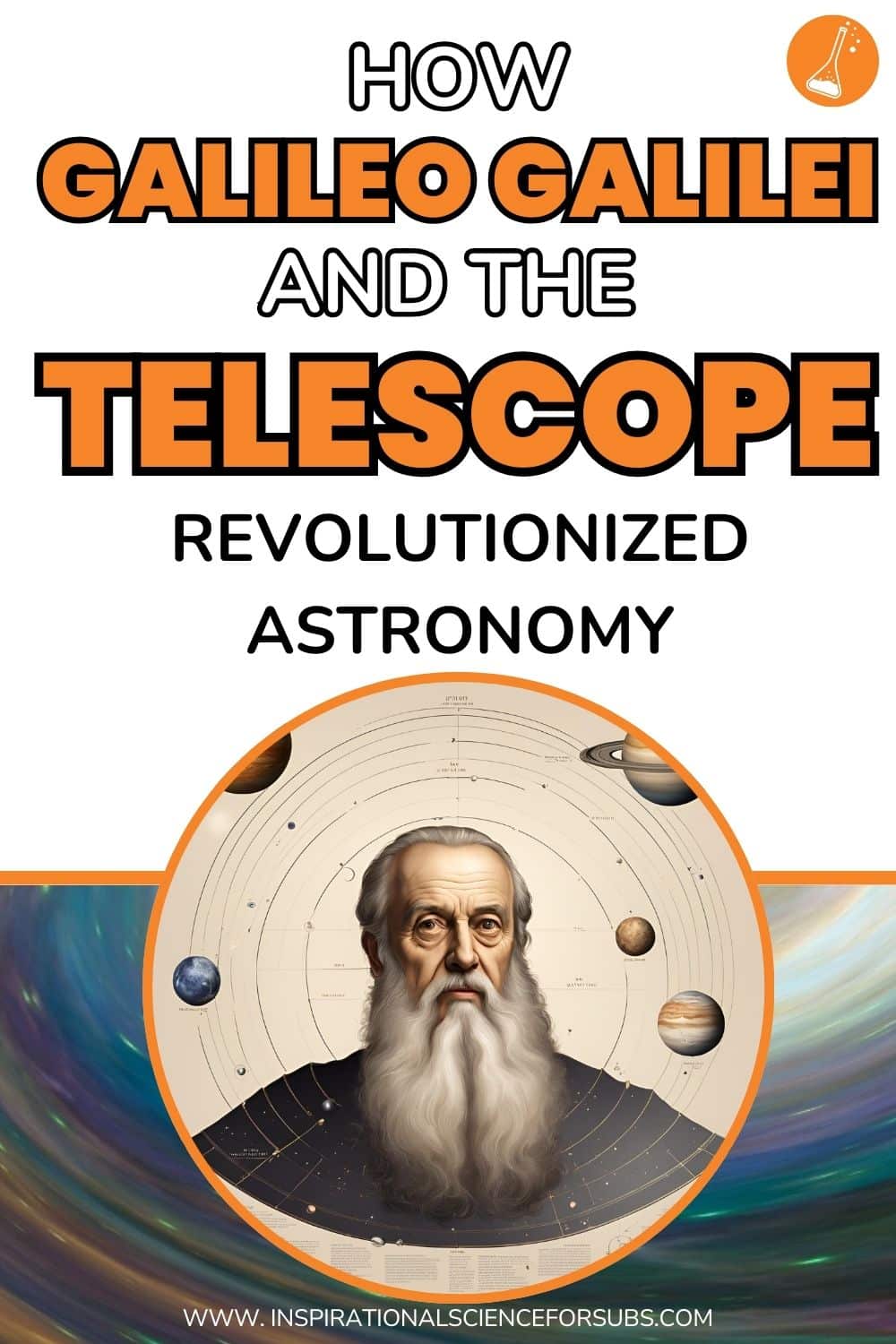
Discover how #GalileoGalilei revolutionised #astronomy with his invention of the #telescope, reshaping our view of the universe! [Read more] @inspirationalscienceforsubs #ScienceHistory #scienceteacher #physicsteacher
More Than Just Astronomy: Galileo's Day Job Dilemma
While we know Galileo Galilei as the Father of Modern Astronomy, his career was actually far broader and, frankly, a bit of a rollercoaster. Being a university professor didn't exactly pay the bills, and he often struggled with money. You'll find that his early career was spent making a name for himself in mechanics and geometry. He didn't just sit in an ivory tower; he had to hustle, just like a lot of brilliant people do!
Check out our Galileo Galilei Word Search on TPT - complete with a WebQuest and Discussion Questions - perfect Bell Ringer tasks!
The Practical Side of Galileo
Before his major astronomical observations, Galileo was known for a few handy, down-to-earth inventions. For instance, he developed an improved version of the geometric and military compass. This wasn't the kind of compass you use for map-reading, mind you, but a calculating instrument—a bit like an early slide rule. He even wrote a manual and personally taught people how to use it, selling the instruments to supplement his meagre academic salary. The geometric compass was incredibly useful for gunners to calculate cannonball trajectories and for surveyors and architects to make quick measurements. It showed a real knack for applied science.
He was also one of the first to propose a design for a thermometer, using the expansion and contraction of air in a glass bulb to indicate temperature changes. It wasn't the precise, sealed device we know today (that came later), but it was a crucial step in the exploration of heat and temperature. It just goes to show you that Galileo Galilei had a mind that could turn to almost any problem and figure out an ingenious solution.
Here’s a great challenge for your students: Galileo struggled with money, despite being a brilliant scientist. If you could invent one simple, practical, and useful device today to earn a living while you worked on your biggest scientific ideas, what would it be?

Dropping the Ball: Challenging Aristotle’s Ancient Authority
The story of the Leaning Tower of Pisa is one of those legendary moments that, while perhaps exaggerated, perfectly captures the spirit of Galileo Galilei. For nearly 2,000 years, the established belief in physics was based on the teachings of the Greek philosopher Aristotle. Aristotle claimed that heavier objects fall faster than lighter ones. It sounds intuitive, doesn’t it?
Experiments and the Power of Observation
Galileo couldn't accept something just because a famous, old authority said it was so. He believed in testing ideas through careful observation and experimentation. The legend says he climbed the Leaning Tower of Pisa and dropped objects of different masses to prove that they hit the ground at the same time (barring air resistance, of course). While many historians doubt the exact event happened in that dramatic fashion, his writings clearly show he performed similar inclined plane experiments to demonstrate his theory. He proved that the acceleration of gravity is the same for all objects, regardless of their weight. This was monumental.
This shift—from blindly accepting ancient wisdom to relying on direct, repeatable evidence—is what truly defines Galileo Galilei as the Father of Modern Science. He showed that your own eyes, guided by a well-designed experiment, were more trustworthy than centuries of tradition. That simple, yet revolutionary, act of questioning set the stage for all modern scientific methodology. It’s a core principle of problem-solving.
Wouldn’t it be a fun exploration for your class to try this? If you had access to a very tall, safe structure (like a drop tower), how would you design a simple experiment to prove or disprove Aristotle's idea that heavier objects fall faster? What equipment would you need?
Famous Scientists: Trailblazers in History
No Prep Lesson Plan
Unleash the inner scientist in your students! This bundle ignites curiosity with five lesson plans on some of history's brightest minds.
Includes Galileo Galilei!
A Life Under House Arrest: Galileo's Final Years
The last decade of Galileo Galilei’s life wasn't spent gazing through his telescope; it was spent under house arrest. Why? Because his exploration into the nature of the cosmos put him in direct conflict with the powerful authorities of the time. His support for the Copernican model—the Sun, not the Earth, is the centre of the solar system (Heliocentrism)—was deemed heresy. You can’t imagine the pressure he must have been under to recant his findings!

Check out our Primary School Venus (The Planet So Hot It'll Melt Your Face Off) lesson plan on TPT - complete with Story Time, Rhyme Time, True/False Factoids, Difficult Words Explained and a Coloring In Activity!
The Two New Sciences: A Scientific Legacy
Despite this immense setback, being confined to his home didn’t stop Galileo’s mind from working. In his final years, while officially forbidden from publishing his astronomical works, he secretly penned one of his most important contributions to physics: Discourses and Mathematical Demonstrations Relating to Two New Sciences. This book, smuggled out of Italy and published in the Netherlands in 1638, laid the groundwork for modern physics.
It wasn't about the planets; it was about the mechanics of materials and motion. He discussed principles like uniform motion, uniformly accelerated motion, and the strength of materials. [Image illustrating Galileo's concept of uniformly accelerated motion] It's in this work that you find the basis for Newton's laws of motion, written even while Galileo was technically a prisoner. Even though his eyesight failed him in old age, his critical thinking and drive to understand the natural world never did. This incredible perseverance proves that true intellectual curiosity cannot be locked away. Galileo Galilei truly pushed the limits of science even in the darkest circumstances.
Ask your class: Imagine you are a scientist today, and you’ve made a discovery that is absolutely true, but a powerful group insists it’s wrong and forbids you from talking about it. What would you do to ensure your discovery is recorded for future generations?
Enjoyed the article?
The Lasting Echo of Galileo Galilei in Your Classroom
Isn't it amazing how much one person can change the world? Galileo Galilei wasn't just a scientist; he was a revolutionary whose commitment to observation and exploration permanently altered the course of human knowledge. He showed us the beauty of a universe far grander than we imagined, and he gave us the fundamental method—the scientific method—to keep looking.
You’ve now got a wealth of stories to share with your US 6–12 students. You can discuss the problem-solving behind his improved telescope, the simple yet profound physics of his experiments on gravity, and the sheer determination that allowed him to publish his final, foundational work on mechanics while under house arrest. These details will help students see the human side of scientific breakthroughs and hopefully encourage them to approach their own learning with the same spirit of curiosity and critical thinking that Galileo possessed. His legacy is one of looking beyond the limits, and that's the spirit we want to instil in every future scientist in your classroom.
Which of these amazing facts about Galileo Galilei do you think will resonate most with your students, and how will you incorporate his story into your next lesson on motion or astronomy? Leave a comment below—you might just spark an idea for another teacher!