

You know the name: Gregor Mendel. He’s right there in the textbook, the father of modern genetics, the monk who messed about with pea plants. But let’s be honest, for many students (and perhaps for some of us, once upon a time!), he can feel a bit… dry. A historical figure reduced to Punnett squares and capital 'T's. That’s a real shame, because the story of Gregor Mendel is one of brilliant persistence, genuine curiosity, and a serious flair for math that totally changed biology. It's a tale that proves big discoveries can come from the quietest corners.
What if you could present Gregor Mendel not just as a scientist, but as a detective who cracked the code of inheritance long before anyone even knew what DNA was? This isn't about memorising vocabulary; it's about seeing how one man, using basic tools and sharp observation, figured out the fundamental rules of life passing from one generation to the next. You'll find that digging a little deeper into the life and experiments of Gregor Mendel offers fantastic hooks to spark critical thinking and problem-solving in your classroom. We hope this content will help you save time and inspire your students, offering them a glimpse beyond the textbook.
More...
The Monastic Lab: Why Peas? Why a Monastery?
It sounds like the setup for a strange joke: a monk, a garden, and thousands of pea plants. But Johann Gregor Mendel’s choice of workplace—the Augustinian St. Thomas’s Abbey in Brno (now in the Czech Republic)—was actually brilliant. First off, as a monk and later as the abbot, he had the time and the space. No need for research grants or university politics; just a peaceful, reliable setting. He had a garden plot, and crucially, access to seeds. You’ve probably got students who find science intimidating, thinking they need a fancy lab. Gregor Mendel proves you don’t! His equipment was simple: a good eye, a notebook, a pencil, and some pea plants.
But why those specific plants? Mendel was a smart cookie. He needed a subject that was easy to grow, matured quickly, and, most importantly, had distinct, clear-cut traits. Pea plants fit the bill perfectly. They have seven easily observable characteristics: seed shape (round or wrinkled), seed colour (yellow or green), pod shape, pod colour, flower colour, flower position, and plant height (tall or short). No confusing in-between shades here. It was a neat, binary system that lent itself perfectly to counting and, later, to what became known as Mendel’s laws of inheritance. He started in 1856 and spent eight long years meticulously crossing, counting, and recording the outcomes of over 28,000 pea plants. That’s dedication!

Check out our Gregor Mendel lesson plan on TPT - complete with Reading Comprehension, a WebQuest, Case Studies and Debate Topics!
More Than Just a Gardener: Mendel’s Mathematical Mind
What truly set Gregor Mendel apart from other plant hybridisers of his time was his statistical approach. Most people simply looked at the results and described them. Mendel counted them—all of them—and looked for patterns and ratios. He was a trained mathematician and physicist, and he applied that rigorous thinking to biology. He didn't just notice that some offspring were tall and some were short; he noticed the consistent 3:1 ratio in the second generation (F2). That ratio was the clue, the mathematical fingerprint that revealed the existence of 'factors'—what we now call genes—that come in pairs, one from each parent.
He wasn’t just doing botany; he was laying the groundwork for probability in biology. Think about that for a second! He figured out the basic mechanism of heredity using only logic and arithmetic, all without ever seeing a chromosome or knowing about meiosis. It’s a powerful lesson in how the right kind of thinking can pierce through complexity.
Question for the Class: If you were Gregor Mendel and couldn’t use pea plants, what other organism or common household item has two very clear, opposing traits that you could easily cross and count to study inheritance? (Think about simple things like coloured beads, different types of buttons, or even different coloured sweets.)
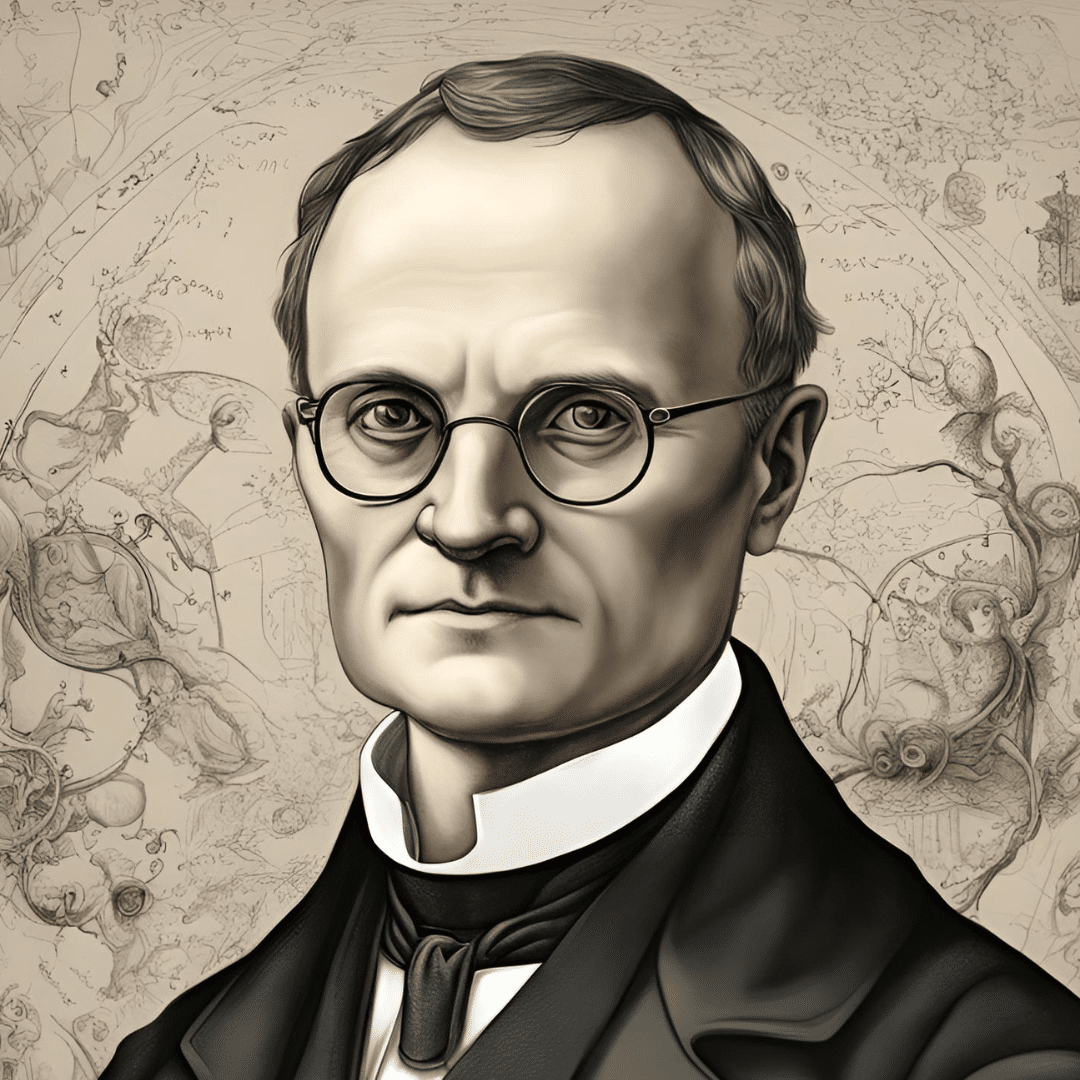
The Dominance Difference: Understanding Mendel’s Factors
One of the most mind-bending insights from Gregor Mendel was his concept of dominance and recessiveness. When he crossed a pure-breeding tall plant with a pure-breeding short plant (the P generation), what do you think happened? Every single plant in the first generation (F1) was tall! The short trait seemed to have vanished completely. For years, scientists believed in the "blending" theory of inheritance—that the traits would just mix like paint, resulting in medium-height plants. Mendel’s results shouted: "No blending!"
He realised that one trait, the dominant one (Tall), was completely masking the other, the recessive one (short). It wasn't gone; it was just hidden. It was still there, lurking in the F1 generation, waiting for its moment. When he then self-pollinated those F1 tall plants, the short trait miraculously reappeared in the next generation (F2), exactly one quarter of the time. This is the cornerstone of Mendel’s first law: the Law of Segregation.

Check out our Gregor Mendel Word Search on TPT - complete with a WebQuest and Discussion Questions - perfect Bell Ringer tasks!
The Law of Segregation: A Biological Flip of the Coin
The Law of Segregation basically says that every individual has two factors (alleles) for each trait, and these factors must separate (segregate) during the formation of gametes (sperm and egg). So, a tall plant from the F1 generation has one 'factor' for tallness and one 'factor' for shortness, but when it makes its own gametes, each one only gets one factor. It’s a fifty-fifty chance.
This is the point where the Punnett square truly becomes a helpful tool, illustrating how those individual, separated factors recombine randomly to produce the F2 generation. It’s a visual representation of Gregor Mendel’s mathematical probability. It explains why two tall parents (who both carry the recessive factor) can occasionally have a short offspring. That's the recessive factor from Mum meeting the recessive factor from Dad. It’s simple, elegant, and perfectly explains why your hair colour isn't just an average of your parents’ colours. It’s a whole lot more exciting than blending!
Question for the Class: If you had two F1 pea plants (both tall, carrying the short factor) and could only choose one of the resulting F2 seeds to plant, but you desperately wanted a tall plant, what are the odds you'd pick one? Why aren't the odds 100%?
How did Gregor #Mendel’s garden experiments shape the future of #genetics? Find out how his work revolutionised the study of #heredity! #ScienceHistory #ScienceTeachers #TeachingScience @inspirationalscienceforsubs
Independent Assortment: Combining Characteristics
Once Gregor Mendel nailed down how a single characteristic, like height, was inherited, he stepped up the complexity. What happens when you track two characteristics at the same time? For example, seed shape (round or wrinkled) and seed colour (yellow or green). Would the colour always stick with a certain shape? Would a yellow seed have to be round, or could it be wrinkled?
This investigation led to Mendel’s second major finding: the Law of Independent Assortment. This law states that the factors for different characteristics (e.g., the factor for colour and the factor for shape) sort themselves into gametes independently of one another. In simpler terms, inheriting one trait doesn't influence the inheritance of another. The two traits are dealt out randomly and separately, like shuffling two different decks of cards at the same time.
The Dihybrid Cross: Getting into the Finer Details
To prove this, Gregor Mendel performed what’s known as a dihybrid cross. He started with parents that differed in two characteristics—say, plants producing Round, Yellow seeds (RRYY) and plants producing wrinkled, green seeds (rryy). The F1 generation was uniformly Round, Yellow (RrYy), showing the dominant traits. It’s the F2 generation, however, that really drives the point home. When the F1 plants are crossed, the traits rearrange in new combinations. You don’t just get the parental combinations back (Round/Yellow and wrinkled/green); you also get two entirely new combinations: Round/green and wrinkled/Yellow.
This new mixture of traits—the new phenotypes—occurred in a very specific, consistent ratio of 9:3:3:1. That 9:3:3:1 ratio is the mathematical proof of independent assortment. It shows that the gene for colour went into gametes regardless of the gene for shape, creating a greater variety of life. Think about humans! This is why you might have your mother’s eye colour but your father’s height. The genes for each feature separate and recombine independently. Gregor Mendel’s work with pea plants really is foundational to understanding the vast, wonderful biodiversity we see around us.
Question for the Class: If the genes for seed shape and seed colour were not independently assorted (if they were always inherited together), what would the ratio of the F2 offspring have looked like? Why would this reduce the variation in the population?
Famous Scientists: Trailblazers in History
No Prep Lesson Plan
Unleash the inner scientist in your students! This bundle ignites curiosity with five lesson plans on some of history's brightest minds.
Includes Gregor Mendel!
Ahead of His Time: The Post-Mendelian World
Perhaps the most fascinating part of the Gregor Mendel story is that, for about 34 years, his work was largely ignored. He published his findings in a little-known local natural history society journal in 1866. He even sent a copy to one of the leading botanists of the day, Karl Nägeli, who was apparently unimpressed, suggesting Mendel try his experiments on different, more complicated plants (which, ironically, obscured the simple ratios). It took three separate European botanists—Hugo de Vries, Carl Correns, and Erich von Tschermak—to independently rediscover his laws in 1900. Only then did the scientific world truly appreciate the magnitude of what Gregor Mendel had achieved.
This rediscovery of Mendel’s laws marked the official birth of genetics as a formal science. Suddenly, Charles Darwin's theory of natural selection—which needed a mechanism for traits to pass down—had its missing piece. Mendel’s 'factors' were eventually linked to chromosomes and DNA, forming the core of all modern biological study, from medicine to agriculture. He was truly a visionary, patiently compiling data on pea plants that would eventually change our understanding of everything alive.
Check out our Gregor Mendel lesson plan on TPT - complete with 6 stunning Case Studies for your Science Ninjas to complete!
From Peas to People: Modern Relevance
Today, we take Mendel's principles for granted. When a doctor discusses a genetic condition, when farmers select for drought-resistant crops, or when forensic scientists use DNA evidence, they are all relying on the foundations laid by this one insightful monk. His careful, mathematical method is a testament to the power of quantitative data in biology. His story is a powerful reminder to your students that sometimes the most profound contributions come not from seeking fame, but from quiet, persistent effort and a commitment to detail. It’s an inspirational tale of an individual who was absolutely right, decades before the world was ready to listen. Gregor Mendel has truly changed the world.
Question for the Class: Gregor Mendel's work was ignored for decades. What do you think is more important for a scientific discovery to be successful: the quality of the science itself, or how well the scientist communicates and promotes their findings to the wider community? Explain your reasoning.
Enjoyed the article?
Conclusion: The Enduring Simplicity of Gregor Mendel
It’s genuinely inspiring to realise that the foundational rules of heredity—the reason you look the way you do, and why a cat always gives birth to kittens and never to puppies—were figured out by a monk in a garden, patiently counting pea plants. Gregor Mendel’s rigorous, mathematical approach showed that traits aren't blended away but are passed on as discrete, countable units, following predictable laws. These laws of segregation and independent assortment have proved to be universal, applying to everything from the simplest bacteria to the most complex human.
You can use the story of Gregor Mendel to inspire your students to see beyond the complexity of genetics and appreciate the simple, elegant patterns underneath. It’s a perfect example of critical thinking and problem-solving in action—how a quiet person, dedicated to a precise method, can alter the course of human knowledge forever. Hopefully, these ideas have given you a few new tricks up your sleeve to make those Punnett squares feel less like maths and more like biological fortune-telling! What part of Gregor Mendel’s life or work do you think students find most surprising or engaging?