

Ever feel like you’re chasing your tail trying to find that one scientific concept that will genuinely blow your students’ minds? Something that connects geography, climate, and pure physics? Well, you're in luck! Today, you’re getting the inside track on the Gulf Stream—a gigantic, swirling river in the ocean that practically keeps half the world running. At Inspirational Science For Subs, you know you'll find the resources to spark that 'Aha!' moment in your classroom. Trust me, the sheer scale of the Gulf Stream is fantastic for inspiring students!
Think of it: an ocean current more powerful than all the world’s rivers combined. Doesn't that sound like a winner for a lesson? You won’t have to waste time re-explaining the same old concepts when you bring the awesome power of the Gulf Stream into your lessons. This essential Atlantic Ocean Current plays a huge part in what makes Western Europe so temperate and green. You’ll be able to link this one natural phenomenon to topics from density and salinity to major weather patterns. You'll see how smoothly this works in class. You’ll find that exploring the Gulf Stream sparks plenty of critical thinking and problem-solving. But what exactly is this colossal Atlantic Ocean Current? Let’s dive in.
More...
The Great Ocean Conveyor Belt: How Water Moves Heat
The Gulf Stream is actually just one part of something much, much bigger: the Atlantic Ocean Current system, or what scientists call the Atlantic Meridional Overturning Circulation (AMOC). Don't let the fancy name put you off; the idea is simple. Imagine a colossal, underwater treadmill that moves water (and heat!) around the planet. That's essentially the Great Ocean Conveyor Belt.
This entire system works on the simple principle of temperature and salinity—how hot and how salty the water is. Near the Equator and in the Caribbean, the Gulf Stream starts as warm, surface water. It gets heated up by the tropical sun, making it less dense, which means it sits right on top. This warm water flows north-eastward right across the Atlantic. This flow is what keeps places like Cornwall, England, and even Norway, much warmer in winter than other locations at the same latitude, like parts of Canada. You might wonder, why doesn't this warm water just pool up in the North Atlantic? Well, that's where the clever part comes in!
The Pull of Cold, Salty Water
As the warm, surface water of the Gulf Stream travels north towards the Arctic, it starts to cool down naturally. Crucially, as the water cools, the remaining water becomes saltier because fresh water evaporates. Cool and salty water is incredibly dense, much heavier than the warm, less salty water it started as. When it reaches the North Atlantic, particularly near Greenland and the Nordic seas, it becomes so dense that it sinks rapidly to the bottom of the ocean. This process is called "thermohaline circulation" (thermo for heat, haline for salt). This sinking water then forms a deep, cold, slow current that travels back south along the ocean floor, completing the loop of the Atlantic Ocean Current. This perpetual movement is what drives the whole Gulf Stream system. Without the sinking water in the north, the warm water wouldn't be pulled north in the first place! It's a fantastic example of a negative feedback loop in nature.
Question for your class: If you could magically alter the temperature or the saltiness of the water in the North Atlantic, what impact do you think that would have on the speed and strength of the Gulf Stream?
Climate Impact: The Great European Heater
It’s easy to forget just how much of an impact this Atlantic Ocean Current has on the atmosphere above it. The Gulf Stream acts like a massive radiator, continuously releasing heat into the atmosphere as it travels north.
The sheer volume of heat moved by the Gulf Stream is staggering. It's estimated that it transports energy equivalent to the output of a million power stations! That warmth is then carried eastward by the prevailing westerly winds right over Western Europe. That’s why the UK, which is on the same latitude as places like Newfoundland, Canada, enjoys relatively mild, wet winters rather than being perpetually frozen. You won't have to waste time looking for a more relatable example of global heat distribution. This is a science concept that you can literally feel. Just imagine how different life would be for the millions of people living in these coastal regions without the moderation provided by the Gulf Stream. It's a key part of our global climate impact.
The Moderating Effect on Western Europe
The climate impact of the Gulf Stream is most noticeable in the winter months. Instead of having bitter cold temperatures dropping far below freezing, much of Western Europe experiences winters where temperatures usually stay above freezing, thanks to the constant flow of this warm Atlantic Ocean Current. This allows for different types of vegetation to flourish and means there’s less snow and ice than there otherwise would be. For students, it's a brilliant way to understand how oceanography directly shapes human geography and ecosystems. It's an incredible example of how interconnected the world's systems are. This natural phenomenon is definitely worth some classroom time.
Question for your class: Besides temperature, what other aspects of the weather (like precipitation or wind) do you think the vast amount of heat energy released by the Gulf Stream would influence?
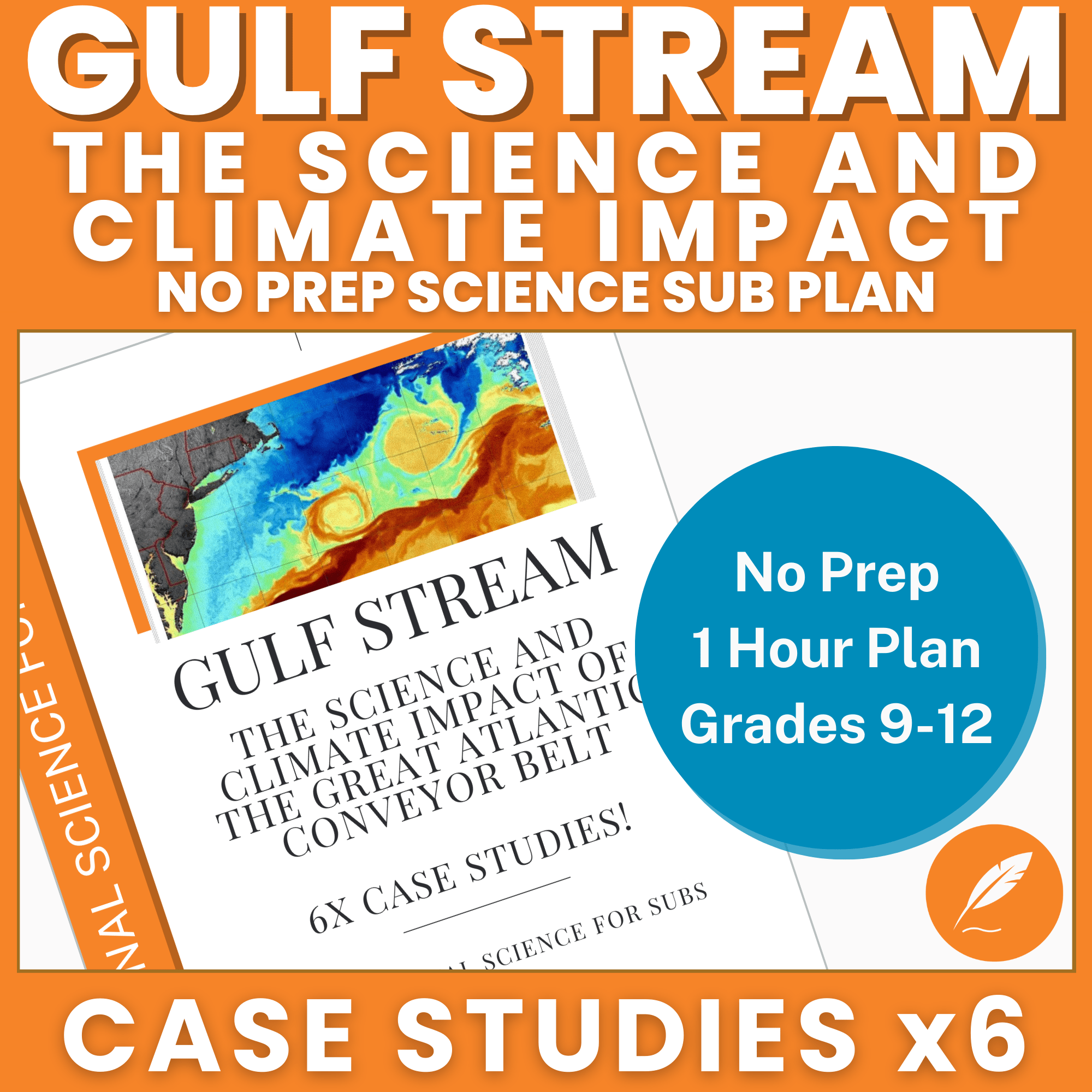
FREE Lesson Plan
Grab this FREE lesson plan for teaching the Gulf Stream!
Includes engaging activities on the Atlantic Ocean Current and its powerful climate impact.
Perfect for grades 6-12.
Save time & inspire critical thinking with a no-prep, ready-to-use resource on the Great Ocean Conveyor Belt.
Download your free resource today!
What Happens if the Gulf Stream Slows Down?
This is where the topic gets really interesting for your middle and high school students, touching on one of the most pressing questions in modern science: what is happening to the Gulf Stream? You've probably heard news stories suggesting the Atlantic Ocean Current is slowing down. Well, current research suggests that it has indeed weakened significantly in recent decades. But why is this happening, and what could be the potential climate impact? It's a real-world problem that demands critical thinking.
The primary culprit scientists point to is the melting of the Greenland ice sheet. That sounds worrying, doesn't it? As huge amounts of freshwater pour into the North Atlantic, it essentially dilutes the saltwater. Remember how the whole system relies on the water being cold and salty to sink? Adding a lot of less-dense freshwater stops the surface water from sinking as efficiently. If the water doesn't sink, the warm Gulf Stream water isn't 'pulled' north as strongly, and the whole conveyor belt slows down. The climate impact of this would be far-reaching and complex, affecting not just Europe, but the entire planet.
Potential Consequences Across the Globe
If the Atlantic Ocean Current slows down dramatically, or even stalls entirely, the effects would be widespread. For Europe, ironically, the immediate effect would be much colder winters. You see, the great European heater would be running on low. Imagine London having winters like Edmonton, Canada! This sudden shift in weather patterns would disrupt agriculture, ecosystems, and infrastructure. But the climate impact isn't limited to the North Atlantic region. Changing the flow of the Gulf Stream also alters global heat distribution.
You'd likely see warmer-than-average temperatures in other parts of the world because the heat is stuck elsewhere. Changes in rainfall patterns, shifts in fish migration, and even stronger storms in the tropical Atlantic could all be consequences. It's a domino effect driven by one massive Atlantic Ocean Current. This topic is a brilliant way to engage students in thinking about complex, interconnected Earth systems.
Question for your class: If the Gulf Stream slows and Europe's winters become much colder, what are two specific ways that this might affect the day-to-day life of people living in the UK or France?
What happens when the Atlantic Ocean Current weakens? Dive into the thermal physics and potential global consequences of a slowing Gulf Stream. Great material for inspiring students! #ScienceLesson #ClimateAction #Educator @inspirationalscienceforsubs
Inspiring Your Students with the Atlantic Ocean Current
So, how can you take this incredible science and turn it into an engaging lesson your 6-12 students will remember? At Inspirational Science For Subs, you know you'll find great material, and the Gulf Stream is a goldmine. You've got everything from thermal energy and density to geography and climate modelling. It’s perfect for encouraging exploration and problem-solving.
The Power of Real-World Data
One of the best ways to teach the science of the Gulf Stream is to use real data. You can find maps of sea surface temperatures and compare the temperatures off the coast of, say, Portugal, with those off the coast of New Jersey—which are at similar latitudes but have wildly different winter temperatures. That difference is a direct illustration of the Atlantic Ocean Current in action. You could even challenge your students to plot the path of the Gulf Stream based only on satellite temperature readings. Trust me, connecting abstract concepts to measurable, real-world data makes a big difference.
It’s not just the physics; the climate impact is an amazing talking point for older students. They can research how a weaker Gulf Stream might influence hurricane intensity or coastal erosion. The sheer scale and power of this Atlantic Ocean Current offer limitless learning opportunities. It’s a wonderful example of science that shapes your world, every single day. You won't have to waste time brainstorming creative projects when the topic is this rich!
Question for your class: Imagine you’re a scientist. What kind of simple, low-cost instrument could you design and launch into the Atlantic Ocean Current to measure its speed and temperature?

Enjoyed the article?
Summary: A Current of Global Importance
Well, there you have it! The Gulf Stream is so much more than just a warm patch of water. It's a critical component of the planet's vast heat distribution system, a powerful Atlantic Ocean Current that directly influences the lives of millions. You've seen how its existence depends on a delicate balance of heat and salt—thermohaline circulation—and how changes to this balance, largely through freshwater influx, could have a major climate impact globally. It's a stunning example of how interconnected all of Earth's systems truly are. You can use this content to save time and inspire your students to see science beyond the textbook, pushing their critical thinking beyond simple limits.
Exploring the Gulf Stream lets you cover concepts from fluid dynamics to global warming in a single, captivating lesson. The power and reach of this Atlantic Ocean Current are undeniable and provide a fantastic basis for classroom exploration. You've got the facts, the science, and the inspiration to bring this giant of oceanography to life. Hopefully, this content will help you save time and inspire your students!
What aspects of the Gulf Stream's climate impact do you find most difficult to explain to your students, and what visual aids do you think would help the most? Let me know in the comments below!