

Today, we’re looking at a true giant: James Clerk Maxwell. You might have heard the name, but do your students truly grasp just how pivotal his ideas were? His work didn't just tweak existing physics; it completely overhauled it. We’re talking about the man who essentially laid the groundwork for everything from radio waves and X-rays to the mobile phone you're probably holding right now. You won't have to waste time re-explaining the same thing because once you introduce them to James Clerk Maxwell, the story just tells itself! His unified theory is one of the most elegant things in all of science. Honestly, getting your students to appreciate the genius of James Clerk Maxwell will really fire up their love of learning. You’ll be able to show them the real-world impact of theoretical physics. Here at Inspirational Science For Subs, you hope this content will help you save time and inspire your students to see science as a limitless learning area!
More...
The Four Maxwell Equations: A Unified Theory
Ask any physicist what the most beautiful set of equations in science is, and there’s a good chance they’ll say Maxwell's equations. This isn't just dry, complicated maths; it's a profound statement about how the universe operates. Before James Clerk Maxwell came along in the 1860s, electricity and magnetism were seen as two separate forces, perhaps related, but not really one and the same. It was like thinking heat and light were totally different phenomena.
James Clerk Maxwell changed all that. He took the experimental work of incredible people like Michael Faraday and André-Marie Ampère, added his own brilliant insight, and tied it all together with four core equations. This unified theory showed, absolutely, that electricity and magnetism aren't just related—they are two sides of the same electromagnetic coin. You can't have one without the other! This is simple, yet revolutionary.
What Do the Maxwell Equations Tell Us?
Each of the four equations describes a fundamental aspect of how electric fields and magnetic fields behave and interact. For example, one equation explains that magnets must always have both a north and south pole—you can't have a lonely north pole floating about! Another tells us that a changing magnetic field will create an electric field.
But the real magic happens when you look at the fourth equation. James Clerk Maxwell actually realised that Ampère's law was incomplete. He added what's known as the 'displacement current' term. Trust me, this small tweak makes a big difference! Once he did that, the four equations naturally yielded a wave equation. And what did this wave travel at? The speed of light! It suddenly became clear that light itself wasn't some special, separate thing; it was an electromagnetic wave. This was a huge "aha!" moment for physics.
If you could meet James Clerk Maxwell and ask him one question about his equations, what would it be?
Light is an Electromagnetic Wave
Think about it: before James Clerk Maxwell, people had theories about light, sure, but they didn’t know what it was made of. Was it a particle? Was it a wave? Isaac Newton had argued for the particle theory. But the wave picture offered by James Clerk Maxwell was something totally new. It established that light is a disturbance, a ripple in the electromagnetic field, made up of oscillating electric and magnetic fields that are perpendicular to each other and to the direction the wave is travelling.
The Spectrum of Electromagnetic Waves
The beautiful thing about Maxwell's theory is that it didn't just explain visible light. The equations didn’t care what the frequency or wavelength of the wave was; they said any combination was possible, as long as the wave travelled at the speed of light. This immediately opened up a whole new world: the entire electromagnetic spectrum!
This includes all the things you use every single day:
- Radio Waves: Your car radio, TV signals.
- Microwaves: Heating up your lunch, mobile phone communication.
- Infrared: Remote controls, thermal cameras.
- Visible Light: What you use to see the world!
- Ultraviolet (UV): Sunburn, banknote checkers.
- X-rays: Medical imaging.
- Gamma Rays: High-energy radiation.
Doesn’t that make you think? James Clerk Maxwell gave us the theoretical proof for all of this, years before most of these waves were even experimentally generated and detected! It's one of the greatest predictive triumphs in the history of science. Understanding that light is an electromagnetic wave fundamentally changed our perception of the universe. It’s what makes James Clerk Maxwell so crucial.
What part of the electromagnetic wave spectrum do you think is most important for daily life, and why?
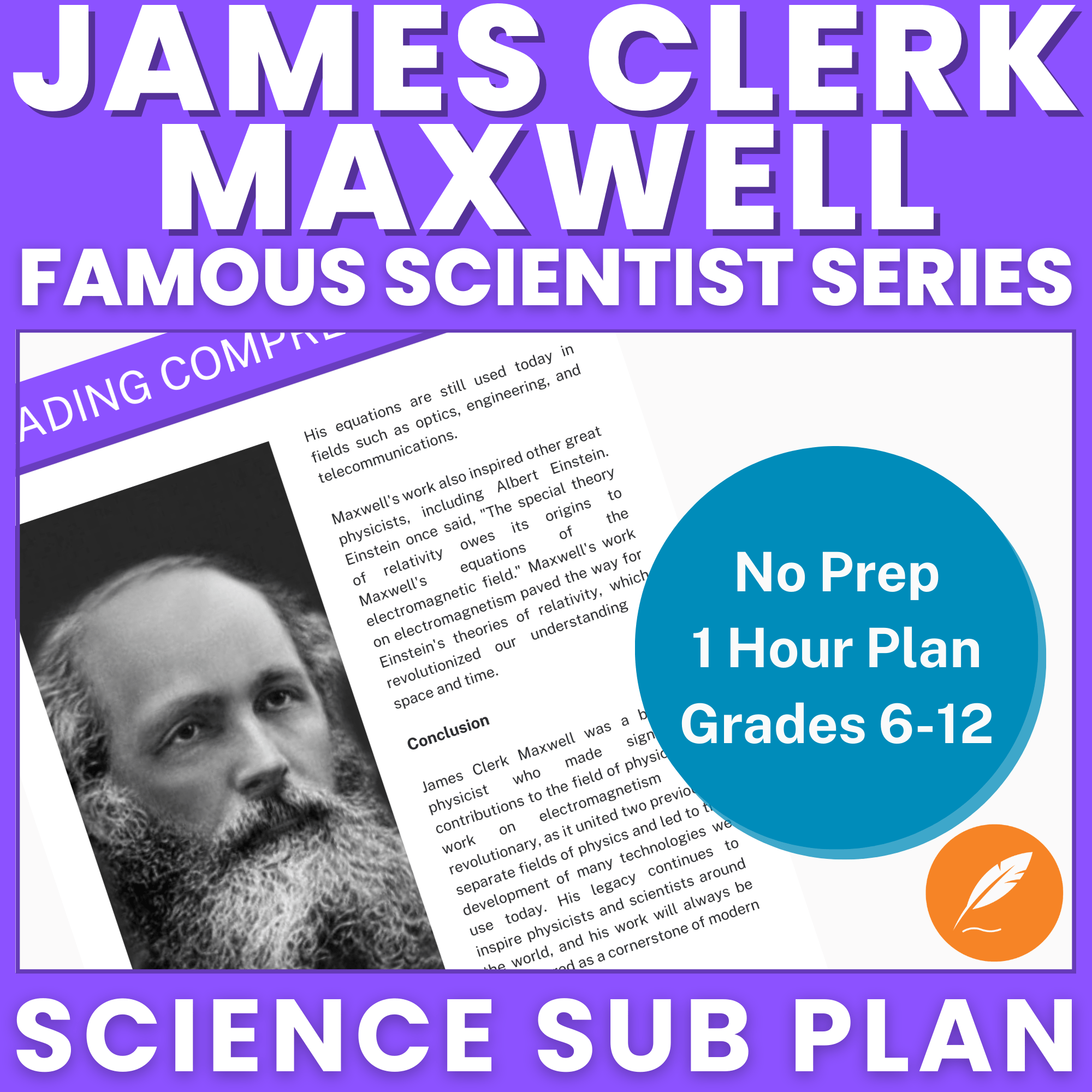
FREE Lesson Plan
Get your FREE lesson plan focusing on James Clerk Maxwell, the father of modern physics! Learn about the four Maxwell equations to explore light as an electromagnetic wave and the three-colour method. Perfect for US Grades 6-12.
Save time & inspire your students!
Setting the Stage for Relativity and Quantum Theory
Here’s where it gets even more fascinating. The work of James Clerk Maxwell didn't just solve a problem; it created a new one—a glorious problem, mind you, that led to the next massive leap in science. His equations predicted that the speed of an electromagnetic wave (the speed of light) should always be the same, regardless of how fast the observer was moving.
Now, that might sound fine, but it clashed head-on with classical Newtonian mechanics, which said velocity should always be relative. Think of it like this: if you throw a ball forward from a moving train, its speed relative to the ground is the speed you threw it at plus the speed of the train. Maxwell's equations suggested that if you "threw" a beam of light, its speed should be just the speed of light, no matter how fast your "train" (or spaceship!) was moving. Weird, right?
A Problem for Albert Einstein
This inconsistency was a real sticking point. For decades, physicists tried to resolve the clash, but it was Albert Einstein who finally provided the definitive answer with his Special Theory of Relativity in 1905. Einstein didn't prove James Clerk Maxwell wrong; quite the opposite. He said, "Maxwell is right, but Newton’s mechanics needs a major update." To make the speed of light constant for all observers, Einstein had to change our understanding of space and time themselves.
So, you could say that the great theories of modern physics—Relativity and Quantum Mechanics—were directly inspired by the fundamental truths uncovered by James Clerk Maxwell. His work on light and blackbody radiation also contained the seeds of quantum theory, specifically the idea that energy might come in discrete packets (or quanta), which Max Planck and Einstein later used to develop quantum mechanics. It’s a foundational cornerstone for all of modern physics.
If you had to summarise the impact of James Clerk Maxwell in just three words, which three words would you choose?
Need a lesson hook? Introduce your class to James Clerk Maxwell, the man who proved electricity, magnetism, and light are one force. It’s unified theory! #ScienceTeaching #EdTech @inspirationalscienceforsubs
The Colour Photograph Pioneer
It's not all pure theory and equations, though. James Clerk Maxwell was a brilliant experimentalist, too, and he made contributions that are much more visual and tangible. You might be surprised to learn that he is credited with creating the world's very first durable colour photograph back in 1861. This is a great fun fact to use with your students!
The Three-Colour Method
He knew that the human eye perceives all colours by combining different amounts of red, green, and blue light. This is called the additive colour system. To prove this, he took three separate black-and-white photos of a tartan ribbon. Each photo was taken through a different colour filter: one red, one green, and one blue.
Then, he used three magic lanterns to project the images, shining the red-filtered image through a red light, the green through a green light, and the blue through a blue light. When the three images were carefully superimposed onto a screen, voilà—a colour image appeared! While the chemical processes weren't perfect at the time (the red filter actually needed some UV light to work well!), the principle was absolutely correct. This three-colour method is still the basis for almost all modern colour reproduction, from the screen you're reading this on to the printer in your office. The work of James Clerk Maxwell is everywhere!
Knowing this, what three items in your classroom do you think depend most on the three-colour method for their function?
Enjoyed the article?
James Clerk Maxwell's Enduring Legacy
The legacy of James Clerk Maxwell isn't just a list of scientific achievements; it's a testament to the power of pure, elegant thought. His work forms the bedrock of what you call classical electromagnetism, which is one of the four fundamental forces in the universe. Everything that relies on radio communication—from GPS systems to satellite TV—owes its existence to the theoretical framework he provided.
He truly was the father of modern physics, providing the essential link between the old physics of Newton and the new physics of Einstein and Planck. He showed us that seemingly separate phenomena—electricity, magnetism, and light—were, in fact, different manifestations of the same single force. That kind of simplification and unification is the highest goal of science. Once you try to explain it this way, you'll see how smoothly the concept works for your students.
What modern technological invention, that relies on his work, do you think James Clerk Maxwell would be most surprised to see?
James Clerk Maxwell: The Final Word on a Science Titan
So, there you have it! James Clerk Maxwell wasn't just a clever chap; he was a revolutionary thinker. You've looked at his crowning achievement, the four Maxwell equations, which demonstrated that light is an electromagnetic wave and unified two major forces of nature. You saw how his work created the speed-of-light puzzle that Albert Einstein needed to solve, leading directly to the Theory of Relativity. And, for a fun, tangible fact for your students, you learned that he was the pioneer behind the three-colour method of photography! He is absolutely crucial to understanding the foundations of modern science. His elegant, predictive theories truly went beyond the textbook and continue to define the limits of what you can achieve today. You hope this content will help you save time and inspire your students to explore the incredible world of physics!
Which of James Clerk Maxwell’s achievements—the four equations or the three-colour photo—do you think will be most engaging for your students? Do let you know in the comments below!