

As a teacher, you’re always looking for innovative resources that spark creativity, and nothing screams "innovation" quite like the raw power of our planet. Today, you’re taking a deep look at natural disasters—the spectacular and sometimes scary ways Earth expresses its power. This topic is brilliant for primary school because it’s tangible, it’s relatable (even if they’ve only seen a massive storm), and it ties straight into critical thinking and problem-solving. You’ll find that focusing on the science behind these events turns fear into fascination, making it a perfect subject for the Science classroom. You won't have to waste time re-explaining the same thing, because these concepts stick! You’ll see how smoothly this works to inspire your students, helping them think beyond the textbook and beyond limits. This post is packed with fascinating facts about how and why these natural disasters happen, giving you everything you need to keep your students captivated.
More...
What Makes an Earthquake a Natural Disaster?
An earthquake is perhaps the most sudden and dramatic type of natural disaster. It’s the Earth literally giving itself a good shake, and that motion is caused by the movement of tectonic plates. Think of the Earth's surface not as one solid shell, but as a giant jigsaw puzzle. These massive puzzle pieces, called plates, are always slowly grinding, pulling apart, or crashing into each other. Most of the time, this movement is too slow for you to even notice. But sometimes, two plates get stuck at their edges. Pressure builds up and builds up, like pulling back a rubber band tighter and tighter. When the rocks finally break or slip past each other, that stored energy is released in waves, and that’s what causes the ground shaking you feel—an earthquake.
The Science of Earth’s Shaking
The place underground where the earthquake starts is called the focus, and the spot directly above it on the surface is the epicentre. You’ve heard of the Richter scale, haven’t you? That’s what scientists use to measure the size, or magnitude, of an earthquake. A magnitude 2 is barely felt, but a magnitude 7 is hugely destructive. It’s an exponential scale, meaning a magnitude 6 is ten times bigger than a 5! You might be surprised to learn that millions of tiny tremors happen every year; it’s only the large, powerful ones that become devastating natural disasters. Understanding how energy moves through the ground is fundamental to understanding this powerful natural event.
- Tectonic Plates: Huge pieces of the Earth's crust.
- Fault Lines: Cracks in the Earth's crust where plates meet.
- Seismic Waves: The energy waves that travel out from the earthquake's focus.
Knowing this science is key. It helps you teach students that these events aren't random magic, but powerful, predictable forces. Plus, it’s great for introducing geographical keywords.
Here’s a question to put to your class: If you could have a seismic sensor to put anywhere in the world, where would you place it to measure the most movement?
Volcanoes: Fire Mountains That Change the Landscape
Volcanoes are another sensational example of a natural disaster, and they're intrinsically linked to those tectonic plates you were just reading about. A volcano is essentially a vent, or an opening, in the Earth’s crust through which hot, molten rock—called magma—erupts from below the surface. Once that magma hits the air, it becomes lava. It’s a spectacular, fiery event! You’ll find most volcanoes near the edges of plates, especially along the famous 'Ring of Fire' in the Pacific Ocean. That’s where plates are constantly colliding or separating, which creates weak spots for the molten rock to escape.
Why Some Volcanoes Are Quiet and Others Are Explosive
You might think all volcanoes are the same, but there are different types, and their shape tells you a lot about how they erupt. Some volcanoes, like the shield volcanoes in Hawaii, have runny, fast-moving lava that flows out relatively gently. These rarely cause explosive natural disasters. But then you have steep-sided stratovolcanoes, like Mount Vesuvius. They have thick, sticky magma that traps gases, causing pressure to build up inside, making the resulting eruption incredibly violent and fast. The eruption can send ash and gas miles into the sky, block out the sun, and sometimes even lead to deadly mudflows called lahars. It’s the speed and force that turns an eruption into a major volcanic natural disaster.
Here’s a question to put to your class: What kind of tools would you invent to safely measure the temperature of the lava flowing from an active volcano?
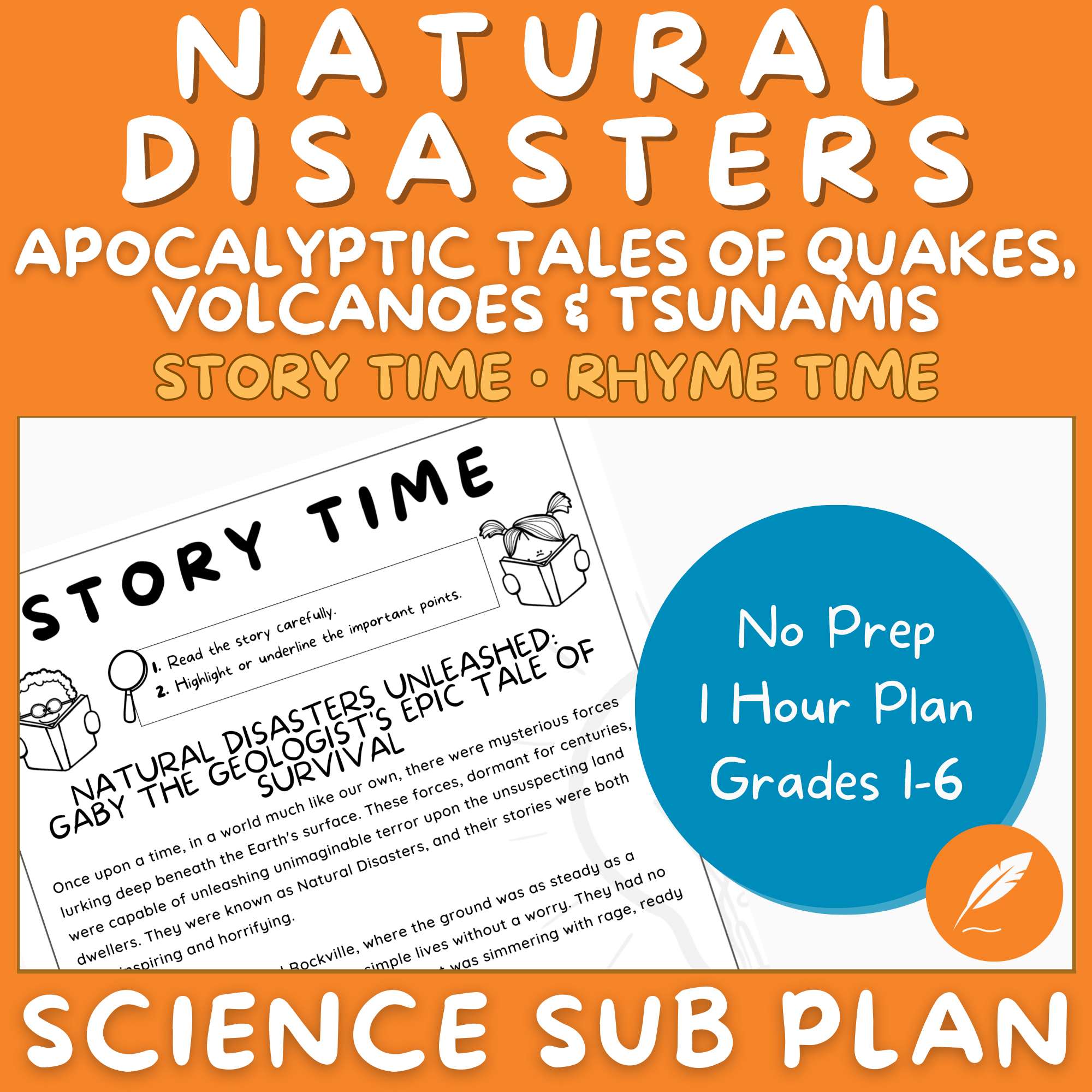
FREE Lesson Plan
Stop scrambling for high-engagement material! Get your FREE Natural Disasters Lesson Plan, perfect for US Grades 1-6 (KS1/KS2). Turn the drama of earthquakes, volcanoes, and tsunamis into powerful science lessons that build critical thinking and safety skills. This resource is packed with facts and discussion questions to inspire students to think beyond the textbook and beyond limits.
Save time and inspire student curiosity today!
The Great Flood: Understanding the Power of Water
When you think about natural disasters, you can't overlook the incredible power of water, particularly in the form of floods and tsunamis. A flood happens when a typically dry area is submerged by water. It’s the most common type of natural disaster worldwide. Floods can happen slowly over days of continuous, heavy rain, or they can be flash floods, happening in minutes due to a sudden downpour or a burst riverbank. These quick-moving floods are extremely dangerous because they carry huge amounts of debris and move with surprising force. Think about that heavy rainfall you sometimes get—it’s amazing how quickly a little stream can turn into a raging torrent!
Tsunami: A Different Kind of Ocean Wave
A tsunami isn’t like the regular waves you see at the beach, is it? It’s not caused by the wind. A tsunami, which is another terrifying form of natural disaster, is usually caused by a large underwater earthquake or sometimes a volcanic eruption or a landslide on the seabed. That sudden movement of the sea floor vertically displaces an enormous column of water. In the deep ocean, the wave is tiny, maybe only a metre high, but it travels incredibly fast—as fast as a jet plane! As it approaches the shallow coast, the water bunches up, slowing down and growing dramatically in height, sometimes becoming a huge, devastating wall of water. This force can travel miles inland. Knowing the difference between a normal wave and a tsunami is vital for coastal safety.
Here’s a question to put to your class: If you could design the ultimate piece of equipment to help people evacuate safely during a coastal natural disaster, what would it look like and how would it work?
The Earth is moving! Use the drama of earthquakes and volcanoes to inspire next-level problem-solving in your classroom. Click for ready-to-use facts! #CriticalThinking #ScienceCurriculum #KS2Science @inspirationalscienceforsubs
Staying Safe: Preparing for Natural Disasters
Teaching students about natural disasters isn't just about the science; it's about empowerment and safety. You’ll inspire your students not by making them fearful, but by showing them that humans can prepare and respond effectively. Every community has a plan for different types of emergencies, and learning these plans is an essential life skill. These preparations turn moments of chaos into actions of confidence.
Community Plans and Practical Skills
For younger students, talking about safety should be practical and simple. You can focus on:
- Earthquake Safety: The 'Drop, Cover, and Hold On' drill. Getting under a strong table and protecting your head.
- Flood Safety: Never walk or drive through moving water. Even a small amount of water can knock you off your feet.
- Emergency Kits: Creating a simple kit with water, a torch (a flashlight), a first-aid kit, and a radio. This is a brilliant hands-on activity for the classroom!
Teaching about natural disasters also encourages critical thinking. You can ask students to think about how different countries might face different kinds of natural disasters. For instance, why would a country like Japan focus more on tsunami and earthquake drills than one like Switzerland? This helps them connect geography with real-world problem-solving. It’s a great way to show how science informs policy and everyday choices.
Enjoyed the article?
Inspiring Action and Thinking Beyond Limits
You know that feeling when a topic really clicks for your students? The science behind natural disasters is one of those subjects that gets every student involved. It’s dramatic, it’s powerful, and it’s a brilliant way to practise critical thinking and problem-solving skills, which is what Inspirational Science For Subs is all about. You’ve now got a treasure chest of fascinating facts about earthquake mechanics, the types of volcanic eruptions, and the differences between a flood and a tsunami. You’re totally equipped to turn these grand, sometimes scary, events into an inspiring lesson that helps students understand the sheer force of the planet they live on. You won’t have to waste time inventing activities; the topic itself is the hook! You'll inspire your students to think beyond limits! What’s one natural disaster that you think is often overlooked in primary science lessons, and how do you plan to incorporate it this term?