

If you’re anything like me, you’ll know that getting a class excited about space is one of the easiest wins in the curriculum. There’s just something inherently magical about those spinning, glowing worlds you share a solar system with. But how do you go beyond the simple "Mercury is hot, Neptune is cold" stuff and really light up that spark of critical thinking? That's what this post is all about.
At Inspirational Science For Subs, you know you get innovative resources that help you push beyond the textbook, sparking creativity and that deep love of learning in your students. This blog post is packed with fascinating facts about our planets—your cosmic neighbours—that you can use to inspire your class, whether you teach primary school children or secondary school students. You’ll find things here that'll make your students' eyes widen and hopefully save you a tonne of time hunting for fresh material. You're teaching science, and science is awesome, so let's keep it that way! Get ready to explore some of the coolest aspects of the planets in our system.
More...
The Rock Planets: Worlds of Extreme Heat and Cold
When you think about the four inner planets—Mercury, Venus, Earth, and Mars—you’re talking about solid, rocky worlds. Geologists call them the terrestrial planets, and each one is completely unique. You’ve got the blisteringly hot Mercury, which, surprisingly, isn't the hottest planet! That honour goes to Venus, thanks to a runaway greenhouse effect. Did you know that on Venus, it actually rains sulfuric acid? Pretty harsh, wouldn't you say?
Getting a Grip on Venus and its Wild Atmosphere
Venus is a fantastic starting point for a lesson on climate science. Its thick atmosphere traps heat so efficiently that surface temperatures hit over 460°C—hot enough to melt lead! It also rotates backward and incredibly slowly; a 'day' on Venus is longer than its 'year.' Imagine that! Your students probably think their school day is long, but a Venusian wouldn't see the sun set for months! This contrast between Earth and Venus is a goldmine for teaching cause and effect in planetary science. Earth and Venus are similar in size, but their atmospheres have sent them down two totally different paths. Why has one planet become a paradise for life and the other a scorching hellscape? It’s a brilliant way to introduce deep concepts like atmospheric pressure and composition.
Mars, of course, is the current focus of space agencies. Its rusty red surface, caused by iron oxide (rust), holds the largest volcano in the solar system, Olympus Mons. This extinct volcano is nearly three times the height of Mount Everest. Just imagine seeing that in person! Mars also has polar ice caps, just like Earth, but they're mostly frozen carbon dioxide. This makes Mars a super interesting planet for exploring the idea of past habitability.
- Mercury: Extreme temperature swings, practically no atmosphere.
- Venus: Hottest planet in the solar system, thanks to a toxic atmosphere.
- Earth: The only one we know of with liquid water and life.
- Mars: Home to the tallest mountain and signs of ancient water flow.
Question for the class: If you could only pack one scientific instrument to send to Mars to prove that life once existed there, what would you choose and why?
FREE Lesson Plan
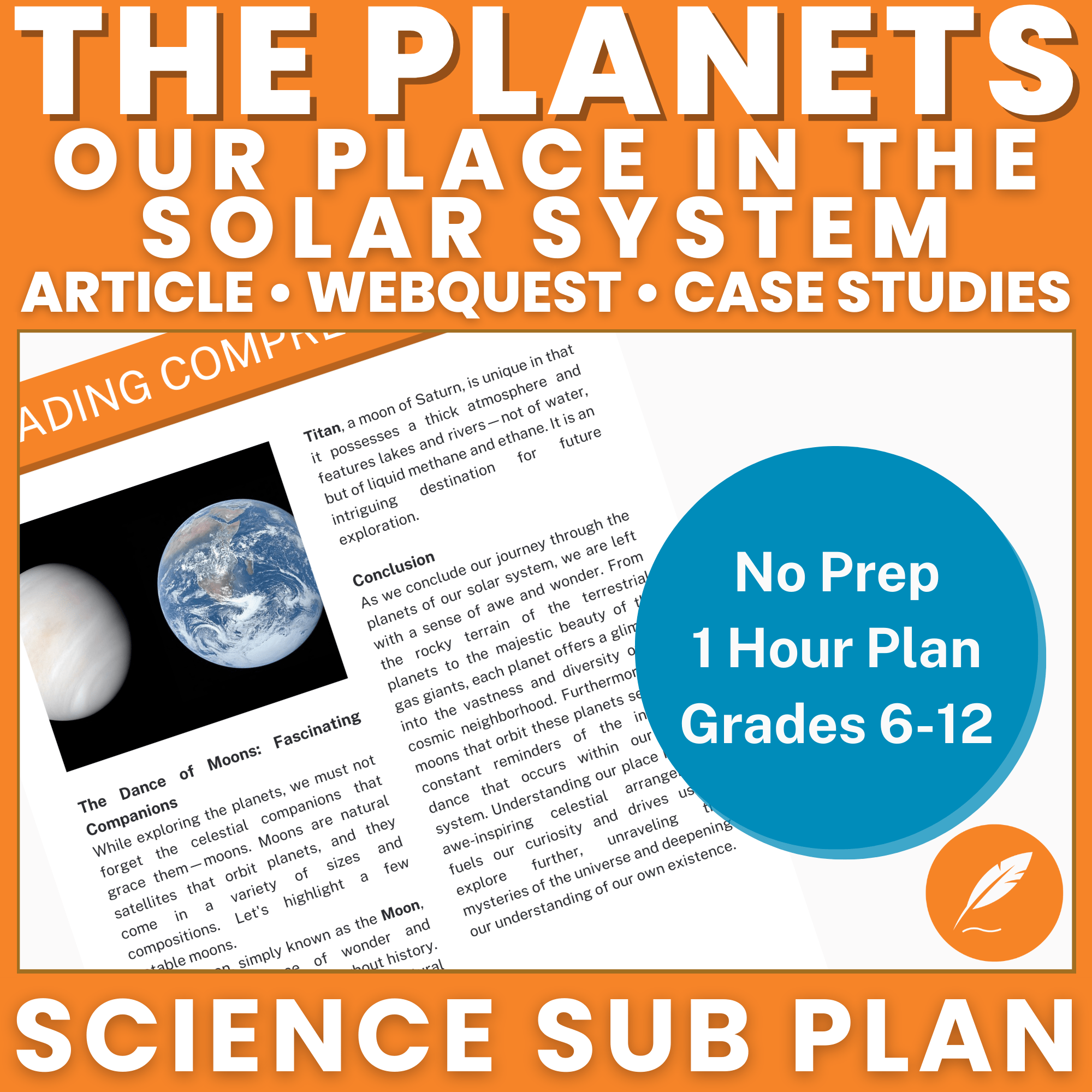
Get an innovative, FREE critical-thinking focused lesson comparing Gas Giants (Jupiter, Saturn) with rocky Terrestrial Planets (Mars, Earth).
Packed with discussion prompts and activities, this resource is perfect for teaching the planets in our Solar System to US Grades 6-12.
Save time and inspire your class!
The Gas Giants: Jupiter and Saturn's Mind-Blowing Scale
Now, let's talk about the big boys: Jupiter and Saturn. These are the planets that make Earth look tiny—and I mean really, truly tiny. Jupiter alone is more than twice as massive as all the other planets combined. It’s essentially a failed star, made mostly of hydrogen and helium. Trying to visualise the scale of Jupiter is a genuinely humbling experience.
Jupiter: King of the Planets and its Great Red Spot
Jupiter is famous for its Great Red Spot, a persistent storm larger than Earth that’s been raging for centuries. Can you picture a hurricane that never, ever stops? It’s a stunning example of planetary weather gone wild. The immense gravity of this enormous planet also gives it the most powerful magnetic field in the solar system, a critical detail for older students studying planetary physics. And then there are the moons! Jupiter has so many moons, it's a solar system in miniature. Io, Europa, Ganymede, and Callisto—the Galilean moons—are worlds unto themselves. Europa, in particular, has a frozen crust with a massive ocean of liquid water beneath it. Could life exist there? It’s a possibility that keeps astrobiologists up at night.
Saturn, naturally, is famous for its breathtaking ring system. You’ll probably have a diagram of it in your textbook, but the reality of those rings is even more amazing. They aren't solid; they're composed of billions of pieces of ice, rock, and dust, ranging in size from tiny grains to house-sized chunks. It's like a cosmic ice rink! These enormous, icy ring systems make Saturn one of the most beautiful planets to observe through a telescope.
Question for the class: If you were the head of a new space mission, would you rather spend £1 billion exploring the atmosphere of Jupiter or the subsurface ocean of Europa, and what would be your primary goal?
FREE Lesson Plan
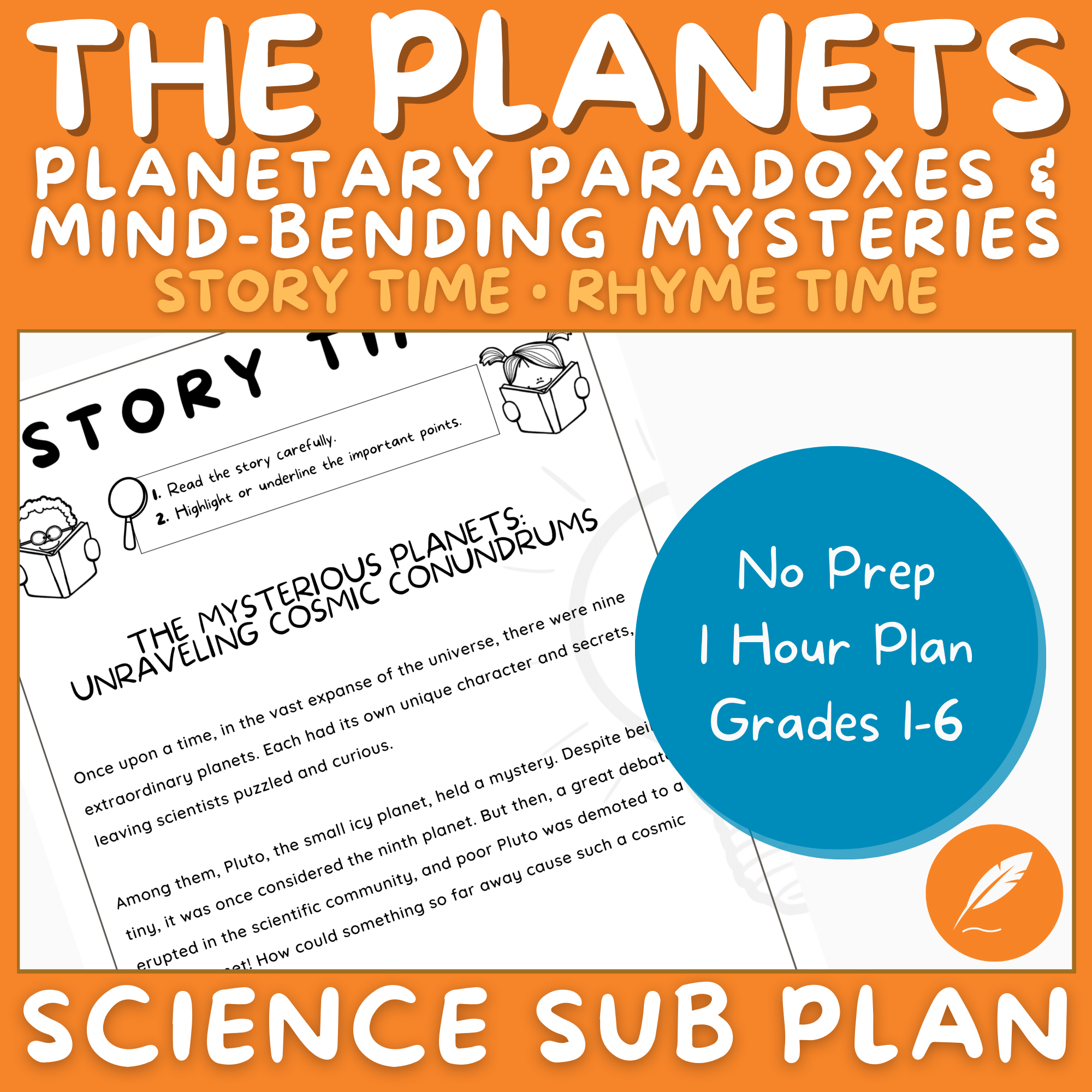
Ready to explore cosmic conundrums that will transform your science curriculum and spark unparalleled student engagement?
Dive into mind-bending planetary paradoxes that make lesson planning a breeze.
Packed with discussion prompts and activities, this resource is perfect for teaching the planets in our Solar System to US Grades 1-6.
Save time and inspire your class!
The Ice Giants: Uranus and Neptune, The Outer Limits
Moving further out into the deep chill, you encounter the ice giants: Uranus and Neptune. These two are often lumped in with Jupiter and Saturn, but they're fundamentally different. While Jupiter and Saturn are mostly hydrogen and helium gas, Uranus and Neptune contain a higher percentage of heavier elements like oxygen, carbon, nitrogen, and sulphur—the building blocks for icy compounds like water, methane, and ammonia. That's why they're called "ice" giants.
Uranus: The Planet Tilted on Its Side
Uranus is the oddball of the planets because it spins on its side. Its axial tilt is nearly 98 degrees! Think about that for a moment. This massive tilt means that one pole experiences 42 years of continuous sunlight, followed by 42 years of continuous darkness. Imagine a school year where it never gets dark! This unique orientation is thought to be the result of a massive ancient collision, and it leads to some incredibly weird weather patterns. For a secondary school class, this is a great topic for discussing angular momentum and conservation of energy. You can talk about how a single massive impact could fundamentally change a planet's characteristics forever.
Neptune, the most distant of the eight planets, is a brilliant deep blue. This striking colour comes from the methane in its atmosphere absorbing red light. It's also home to the fastest winds in the entire solar system, with speeds of over 2,000km/h. These incredible winds whip up giant storms, like the Great Dark Spot, which was comparable in size to the Earth when Voyager 2 saw it. These outer planets are truly dynamic places, even though they’re so far from the Sun. What do you think causes such ferocious winds on a world that gets so little solar energy? It’s a great question to throw out there!
Question for the class: If the Earth were suddenly tilted by 98 degrees like Uranus, how would daily life and the seasons change in your town?
Did you know one Planet's day is longer than its year? Hook your students with weird weather & wild scale using these deep-dive facts on the Planets in our Solar System. #ScienceTeacher #STEM @inspirationalscienceforsubs
Dwarf Planets: Pluto and Beyond
Once you've covered the eight main planets, there’s still plenty more to talk about! The dwarf planets—especially Pluto—are brilliant for sparking debate and critical thinking. The decision in 2006 to reclassify Pluto from a main planet to a dwarf planet caused quite a stir, didn't it? It’s a perfect example of how science isn't a fixed set of facts but a constantly evolving process based on new data and clearer definitions.
Why Pluto Isn't a Planet Anymore: Clearing the Neighbourhood
The International Astronomical Union (IAU) set three criteria for being a full-fledged planet:
- It must orbit the Sun. (Pluto does this.)
- It must be massive enough for its own gravity to make it nearly round. (Pluto does this.)
- It must have cleared the neighbourhood around its orbit. (Pluto fails here.)
That last point is the kicker. Pluto sits in the Kuiper Belt, a doughnut-shaped region beyond Neptune full of thousands of other icy, rocky bodies. It hasn't "cleared" its path; it shares its orbital neighbourhood with many other large objects. Therefore, it’s classified as a dwarf planet, along with bodies like Eris, Ceres, Makemake, and Haumea. The existence of these other dwarf planets in the Kuiper Belt really highlights the vastness of our solar system and the fact that there's still so much out there we don't fully understand.
This isn't just a technicality; it’s a brilliant way to teach your class the scientific method and how definitions are made and refined. It proves that even huge concepts, like what a planet is, aren't immune to change.
Question for the class: Do you think the IAU made the right decision about Pluto, or should the definition of a planet be changed again to include it? Why or why not?
Enjoyed the article?
Summary: Inspiring Your Future Astronomers
Hopefully, these fascinating facts about our cosmic neighbours have given you a few new arrows for your teaching quiver. You're now armed with conversational, specific details about the terrestrial planets, the colossal gas giants, the icy outer worlds, and even the controversial dwarf planets. You've got stories of storms bigger than Earth, tilted axes, acid rain, and vast underground oceans. These are the hooks that transform a regular science lesson into an unforgettable moment of wonder.
Remember, the goal is always to inspire your students, helping them move beyond simply memorising facts to truly engage in critical thinking and problem-solving. By presenting these awesome planets with fresh details and great questions, you're not just teaching astronomy; you're nurturing the next generation of scientists and thinkers. That's what we’re all about here at Inspirational Science For Subs—moving beyond limits to light up learning. Thank you for doing the incredible work you do every day!
Which of these fascinating facts about the planets do you think will get the biggest 'wow' reaction from your class? Drop a comment below!