

You know how sometimes the most important topics—like how we power our entire world—can feel a little dry in the textbook? Well, it doesn’t have to. You're constantly looking for innovative resources that spark creativity in your students, and talking about renewable energy is one of the best ways to ignite that love of learning! Think about it: the sun is a massive, ongoing fusion reactor, and you've figured out clever ways to catch some of that constant, powerful light. Isn't that wild?
This blog post is all about giving you some fun facts and great stuff that you might not know, content that you can use to keep your students engaged and thinking critically. You're teaching them about a fundamental shift in how people get power, moving away from things that can run out toward sources that nature keeps on providing. It’s all about the science behind sources like solar, wind, and hydro, and how the clever application of physics and engineering is bringing us a cleaner, more sustainable future. You won’t have to waste time inventing a compelling angle; you’ll have a wealth of interesting facts ready to go!
More...
Solar Power: Turning Sunlight into Sparks
Let's kick off with the biggest star in the renewable energy show: solar power. Truly, what could be more fascinating than capturing literal sunlight and turning it into something that runs your television or lights your classroom? It sounds like science fiction, but it’s real-world physics! You're probably familiar with the big, black panels you see on rooftops, but the actual science that makes them work is truly mind-boggling. It involves something called the photovoltaic effect. When light hits the silicon in a solar cell, it knocks electrons loose, creating an electric current. Simple, right? But that small tweak in materials makes a massive difference!
The Science Behind the Silicon
The secret sauce is the silicon. It's treated with other elements, making one layer electron-rich (the n-type layer) and the other electron-poor (the p-type layer). When these two layers meet, an electric field is established at the junction. When sunlight (made up of photons) strikes the panel, those photons inject energy into the silicon atoms, freeing the electrons. That internal electric field then forces those free electrons to move in one direction—bingo, you've got direct current electricity! You can then use inverters to change that DC into the alternating current (AC) needed for most homes and businesses. This is how you get clean power straight from the sun. Think about the sheer volume of power hitting the Earth every second; you’re only capturing a tiny fraction, but it's constant and reliable. It’s a brilliant example of problem-solving.
- Fact for the Classroom: A single hour of sunlight could theoretically meet the entire world's energy needs for a whole year. You can talk about the challenge of storing that solar energy!
- Discussion Question: If you could cover the entire roof of your school with the most efficient solar panels imaginable, what kind of new technology or club would you fund with the savings on the electricity bill?
Wind Power: The Invisible Force of Renewable Energy
Next up, let's talk about wind. People have used wind to power things, like sailing ships and grinding grain, for centuries. But transforming wind into modern electricity, that’s where the real engineering innovation lies. These colossal wind turbines you see on hillsides or out at sea are marvels of mechanical design. They don't just spin; they capture the kinetic energy of moving air masses. The long, sweeping blades are aerodynamically designed—a lot like an aeroplane wing—to create lift and turn a rotor, which is connected to a gearbox and then to a generator. This process directly produces electricity.
Why Offshore Wind is a Big Deal
You might wonder why you're seeing more and more of these turbines moving out into the sea. That’s offshore wind power, and it’s a massive growth area for renewable energy. Why? Because the wind over the ocean is generally stronger, more consistent, and less turbulent than it is over land. Also, you're not using up valuable land space. Building these massive structures in the ocean is an absolute logistical feat, but the return is huge in terms of consistent clean energy generation. The sheer scale of some of these projects is jaw-dropping! Imagine teaching your students about the engineering required to anchor a structure taller than the Shard in deep water. You've got to admit, that's pretty inspiring stuff.
- Fact for the Classroom: The largest wind turbines have blades that can measure over 100 metres long! That's longer than a football pitch!
- Discussion Question: Wind turbines are an amazing source of renewable energy, but they sometimes face criticism for affecting birds or being visually intrusive. If you were an engineer, what creative solutions could you design to address these common concerns while still producing plenty of wind energy?
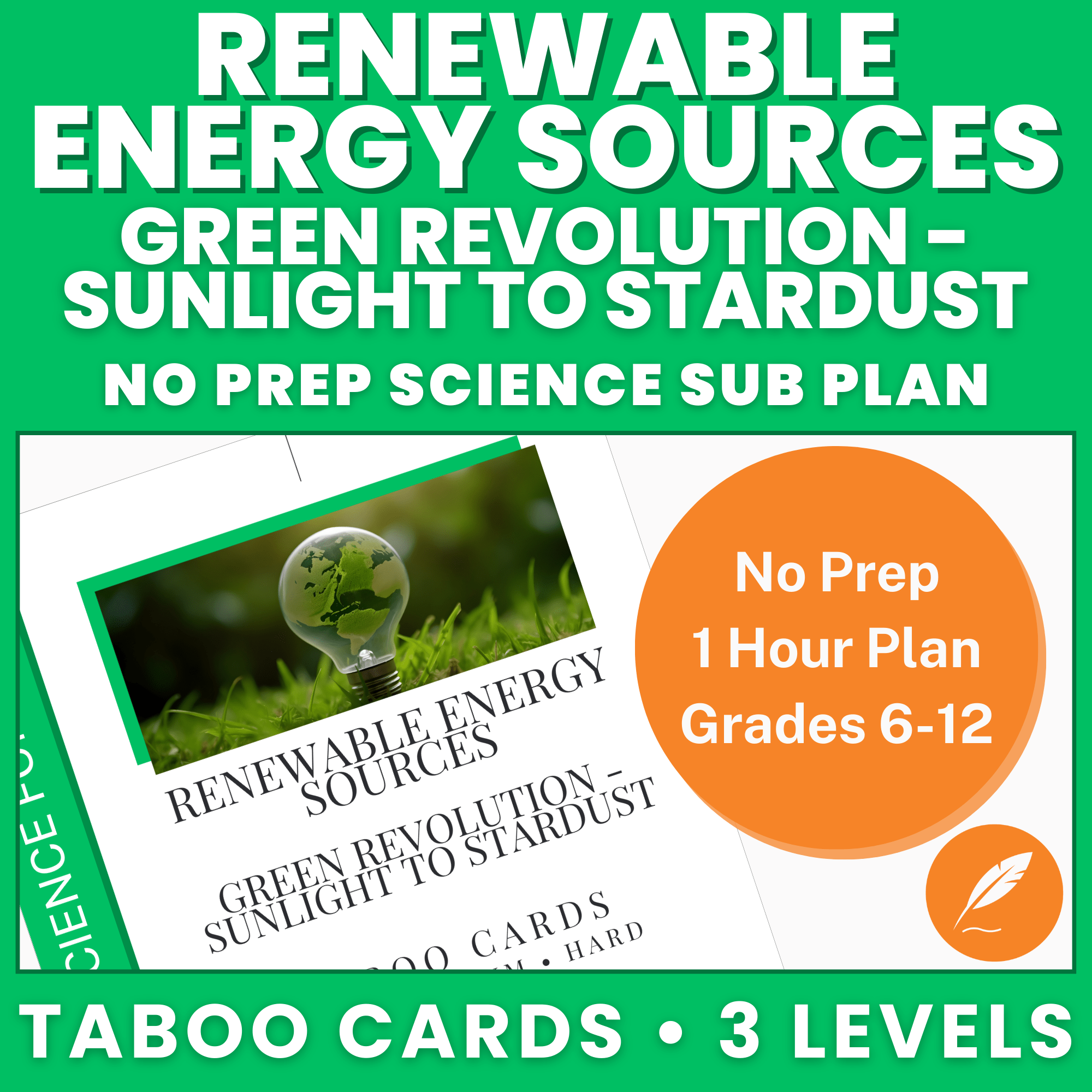
FREE Lesson Plan
Grab your free, unique set of Taboo Cards on Renewable Energy and Clean Power! Designed for US Grades 6-12, this set includes topic cards, restricted word lists, engaging facts on solar, wind, and geothermal, and activities to promote critical thinking and vocabulary mastery. Perfect for sparking a love of science and problem-solving in your students. Stop searching and start teaching sustainable, innovative science today.
Hydro Power: Taming the Flow of Water
Ah, water power—or hydro power. This is arguably the oldest and most established form of large-scale renewable energy. For millennia, people have used the sheer force of flowing water to do work. Today, massive dams like the Three Gorges Dam or the Hoover Dam use this same basic principle, just scaled up exponentially. Hydroelectric power is straightforward: you control the flow of a river, creating a reservoir of water held at a high elevation. This water holds a vast amount of gravitational potential energy. When this water is released, it rushes down through large pipes (called penstocks) and spins a turbine, which is connected to a generator to create electricity.
Run-of-River Systems vs. Dams
Not all hydro power involves building colossal dams, though. You should tell your students about 'run-of-river' systems. These are smaller, less impactful systems that divert a small portion of a river's flow through a channel and a turbine, then immediately return the water to the river downstream. This method generates less energy than a huge dam but has a much smaller environmental footprint, which is a great talking point for a lesson on sustainable engineering and local resource management. They don't store water like a dam; they simply use the river's natural flow, making them a fantastic example of using natural forces without fundamentally changing the landscape too much. It truly showcases a careful balance between clean power generation and ecological preservation.
- Fact for the Classroom: When a hydroelectric dam is operating, it can adjust its electricity output almost instantly, making it one of the most reliable forms of renewable energy for balancing the power grid.
- Discussion Question: Building a large hydroelectric dam creates a lot of renewable energy, but it drastically changes the local ecosystem and human communities. If you were a local council official, what would be the single most important factor you’d consider before approving a new large-scale hydro project?
Beyond the textbook: Discover the genius physics and engineering that turns sunlight and wind into clean power. Fantastic facts for US Grades 6-12! @InspirationalScienceForSubs #ScienceEd #RenewableEnergy
Geothermal Energy: Heat from the Earth's Core
Let’s move on to something completely different: geothermal energy. This is perhaps the most stable form of renewable energy, as it taps directly into the Earth’s constant internal heat. Think of it as Mother Nature’s perpetual boiler! Deep below the crust, there’s an incredible amount of heat from the planet's formation and the decay of radioactive materials. In certain spots, this heat is closer to the surface, especially near tectonic plate boundaries (like in Iceland, the US, or New Zealand). Engineers drill deep wells to tap into underground reservoirs of hot water and steam. This steam or hot fluid is then used to spin turbines and generate electricity.
Direct Use Geothermal Systems
And get this: you don’t even need super-heated steam to use the Earth’s thermal energy. Even if you don’t live near a volcanic area, you can use shallow geothermal heat for heating and cooling buildings right now. This is where geothermal heat pumps come in. The ground just a few metres below the surface stays at a relatively constant cool temperature year-round. These systems circulate fluid through underground pipes. In the winter, the fluid absorbs the Earth’s warmth and brings it inside; in the summer, it pulls heat from the building and dumps it back into the cooler ground. That's using clean power for air conditioning! Trust me, this small tweak in how you think about the ground beneath your feet makes a big difference to your energy costs and carbon footprint.
- Fact for the Classroom: Iceland generates almost all of its heat and electricity from geothermal and hydro power, making it a world leader in renewable energy adoption.
- Discussion Question: Geothermal power is wonderfully reliable. However, it’s currently geographically limited to certain areas. If you could somehow transport the intense heat from deep underground to any city in the world, what city do you think would benefit the most and why?
Enjoyed the article?
The Future of Clean Power: Storage and Innovation
So, you've seen how solar, wind, hydro, and geothermal power all offer ways to generate continuous clean power. But there’s one challenge you should definitely bring up with your students: intermittency. The sun doesn't always shine, and the wind doesn't always blow. That's why the current big push in renewable energy research isn't just about making better solar panels; it’s about making incredible, huge, efficient ways to store the energy when it’s being made so you can use it later. Think about what a sustainable energy system truly needs.
Beyond Batteries: New Storage Solutions
While lithium-ion batteries are great for electric cars and residential backup, they can be expensive and resource-intensive on the scale of an entire city's power grid. That’s why scientists are exploring alternatives. You can talk about things like Pumped Hydro Storage, where surplus electricity is used to pump water up a hill into a reservoir, and when power is needed, the water is released to generate electricity again—like a giant battery! Or maybe you’ll focus on thermal storage, where excess solar energy is used to heat up massive tanks of molten salt, which can then hold that heat for days and be used to generate steam and power later. These ingenious solutions ensure that the renewable energy created during peak production is never wasted.
- Fact for the Classroom: Molten salt storage systems can keep heat hot enough to generate electricity for more than a week after the sun has set. That’s reliable clean power!
- Discussion Question: Imagine your school could invent a revolutionary new way to store large amounts of renewable energy. Would your solution involve gravity, heat, compressed air, or something completely different? Describe how it would work to ensure your town never runs out of sustainable energy.
Bringing Renewable Energy Back to the Classroom
Wow! You've got so much to work with now. From the massive power of the sun to the deep-seated heat of the Earth, renewable energy sources are a perfect topic for demonstrating how science truly is beyond the textbook and how human ingenuity has no limits. You're giving your students more than just facts; you’re sparking their critical thinking and problem-solving skills by showing them how the world’s most pressing problems are being tackled with science. You can feel good knowing you're offering innovative resources that will truly inspire your students. They won’t have to guess what a sustainable future looks like; you’re showing them the building blocks right now!
You've learned about the amazing photovoltaic effect, the aerodynamics of huge turbines, the physics behind hydroelectric power, and the stability of geothermal systems. Remember, every time you teach a concept related to clean power, you’re encouraging the next generation of engineers, physicists, and environmental scientists. You’re inspiring them to continue this limitless learning journey.
Do you think you’ll spend more time on the physics of solar panels or the engineering challenge of offshore wind power this term? Let me know which of these topics you think will engage your middle school or high school students the most in your next lesson!