

You know, when you’re prepping for a science lesson, especially one that students think they already know, like the skeletal system, it can feel like a bit of a challenge to keep things fresh. You want to offer innovative resources that really spark that critical thinking and ignite a true love of learning, right? That’s what this post is all about. You’ll find some fantastic facts and talking points here that go way beyond the standard textbook description of bones just holding you up.
The skeletal system is genuinely a scientific marvel. Think about it: this internal framework lets you run, dance, sit, and even protects your most vital organs. It’s a dynamic, living tissue, not just a pile of calcified sticks! When you explain the human skeleton this way, you make it immediately more relatable and interesting. You’ll save time looking up those engaging extras, and hopefully, inspire your students to see their own bodies as incredible problem-solving machines. Let's get into the bones of it!
More...
The Human Skeleton Isn’t Just a Coat Rack: Support, Movement, and Protection
It's tempting to think of the skeletal system simply as the scaffolding that prevents you from flopping onto the floor. And while support is definitely its primary function, that’s just scratching the surface. Your human skeleton is an incredibly sophisticated organ system, and it's constantly changing. Did you know the average adult has 206 bones? But babies start with closer to 300! It’s all down to ossification and fusion as you grow. That’s a brilliant fact to drop into any lesson.
But let's look at its three main jobs. First, there’s support. Without the bony architecture of the skeletal system, your muscles wouldn't have anything to pull against, and your body shape simply wouldn't exist. It's the sturdy frame that keeps everything else in place. Secondly, movement. This is where the magic really happens. Joints act as pivots and hinges, allowing motion when muscles contract. It’s a beautifully simple mechanical system, yet it allows for the complex grace of a dancer or the precision of an artist.
How Bones Protect Your Vitals
Finally, and perhaps most dramatically, is protection. Think about the rib cage, that beautifully curved structure. What’s it safeguarding? Your heart and your lungs! Or the cranium, a hard, strong dome. It’s the ultimate helmet for your most precious organ, the brain. The pelvis also offers crucial protection for parts of the digestive and reproductive systems. You're teaching biology, but you're also touching on engineering and mechanics, which is great for sparking that critical thinking.
The human skeleton even protects itself. Bones have an outer layer of compact bone that's incredibly dense and strong, and an inner layer of spongy bone that's lighter and slightly flexible. This balance of strength and lightness is what makes the whole system so efficient.
- Teacher question for the class: If you could add one extra layer of bony protection to an area of the body that currently doesn’t have it, where would you put it and why? (Think about activities like sports or falls!)
Bone Marrow: The Factory Inside Your Skeletal System
When most students think of bones, they think of the hard, white stuff. They rarely picture the gooey, amazing stuff inside: bone marrow! This is where the skeletal system becomes less about structure and more about lifeblood. It’s the body's secret factory, working tirelessly behind the scenes.
There are two main types of bone marrow: red and yellow. Red bone marrow is the haematopoietic tissue—that means it’s responsible for making blood cells. Every single day, your body produces millions upon millions of red blood cells, white blood cells, and platelets. Red blood cells carry oxygen, white blood cells are your immune system’s defenders, and platelets help your blood clot. All this vital production happens right inside your bones, making the skeletal system a central component of overall health. Isn’t that astonishing?
Yellow Marrow: Storing Energy for a Rainy Day
Yellow bone marrow, on the other hand, is primarily fat cells. Now, you might think fat is just fat, but this type is a crucial energy reserve. In an emergency, or during periods of severe blood loss, the body can convert yellow bone marrow back into red bone marrow to step up blood cell production. It’s a built-in safety mechanism that shows just how dynamic and responsive the human skeleton is.
So, when a student breaks a leg, you can explain that the bone isn't just a casualty; it's a hive of activity, immediately sending signals to start the repair process while the marrow keeps producing the cells that help transport nutrients and fight off infection. That’s not just a bone; that’s an entire ecosystem inside a mineral structure! When you teach the skeletal system like this, you’re encouraging problem-solving skills by getting students to think about the body’s internal solutions.
- Teacher question for the class: If bone marrow is constantly making new blood cells, what do you think happens to the old, worn-out blood cells? Where do they go, and what system is responsible for getting rid of them?
FREE Lesson Plan
Grab your FREE lesson plan for teaching the Skeletal System! Go beyond support and movement to explore bone marrow’s blood factory role and the amazing process of bone remodelling.
Perfect for sparking critical thinking in US Grades 6–12.
Save time planning and inspire your students with these innovative, high-engagement resources!
The Bone Building Blocks: Cells, Minerals, and Collagen
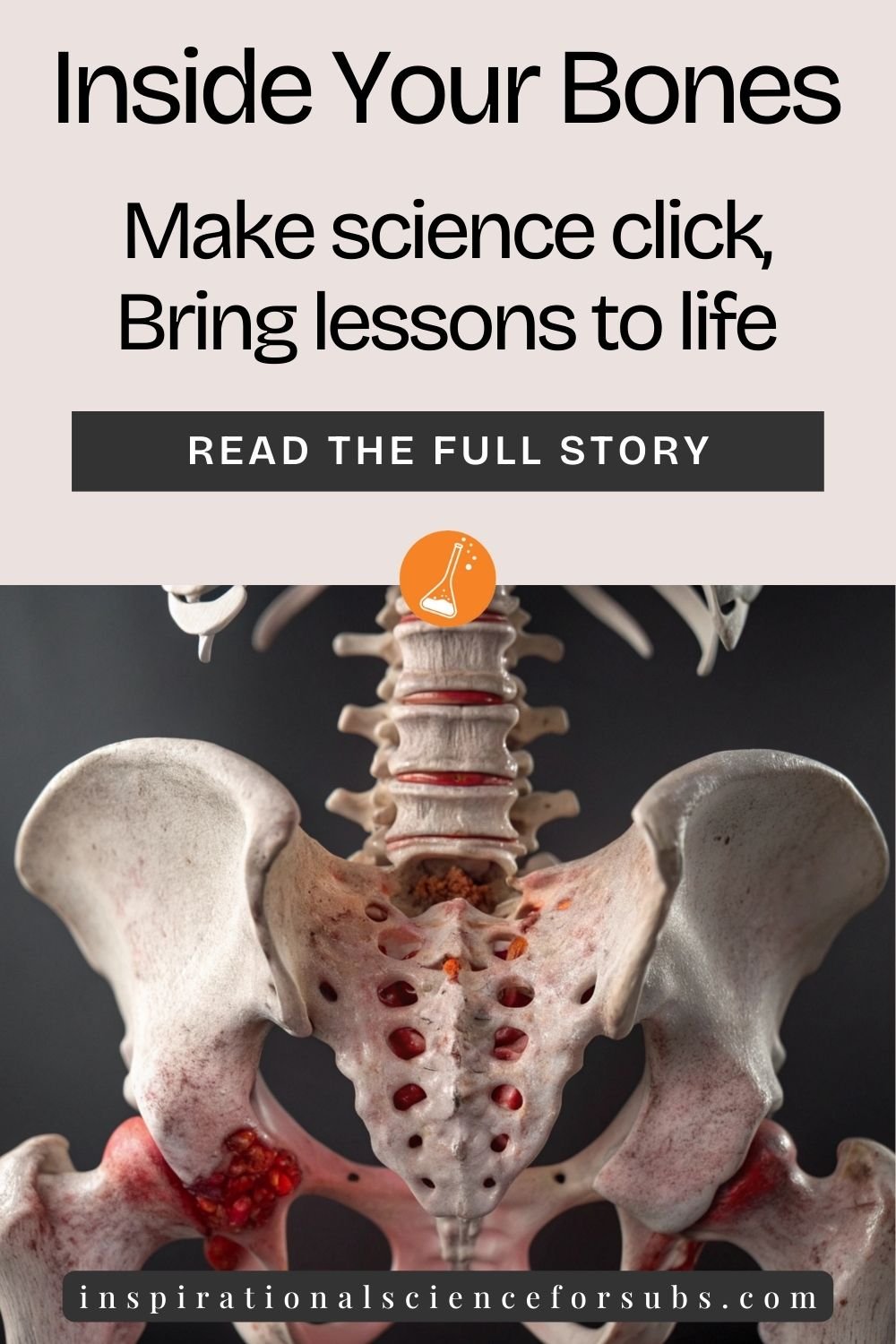
Bones aren't static; they're very much alive. A bone is composed of cells, the mineral calcium phosphate (which gives bone its hardness), and collagen (a protein that provides flexibility). It’s this combination that makes the skeletal system both incredibly strong and resilient. It’s like a perfect composite material—think of how engineers combine materials to get the best properties.
You’ve got a couple of key cell types you must mention to really explain the growth and maintenance of the human skeleton: osteoblasts and osteoclasts. Osteoblasts are the builders; they lay down new bone tissue. Osteoclasts are the recyclers; they break down old, damaged, or unnecessary bone tissue. This constant process, called bone remodelling, is happening all the time. Your entire skeletal system is replaced about every ten years! That’s why exercise and good nutrition are so vital, especially for teenagers whose bones are still growing and solidifying.
Bone Remodelling: The Constant Repair Job
Bone remodelling ensures that the human skeleton can adapt to the stresses placed upon it. If you start a new sport, the bones in your limbs will, over time, become slightly thicker and stronger to handle the increased load. If you break a bone, those osteoclasts go in and clean up the mess, and the osteoblasts come in to build a new, strong bridge of bone tissue. It’s one of the most brilliant examples of biological self-repair.
You can use this fact to drive home the importance of calcium and vitamin D. Calcium is the raw material the osteoblasts need, and vitamin D helps your body absorb that calcium. It’s a great way to link biology lessons directly to student life and choices. Trust me, linking the science of the skeletal system to things they eat and activities they do makes a big difference in comprehension.
- Teacher question for the class: If osteoclasts are constantly breaking down bone tissue, what do you think would happen if they became too active and worked faster than the osteoblasts? What effect would that have on the strength of the bones?
Why is the skeletal system so vital? It supports, protects, and makes your blood! Grab these innovative lesson points now. #MiddleSchoolScience #BiologyTeacher @inspirationalscienceforsubs
Cartilage, Ligaments, and Tendons: Skeletal System Helpers
The bones themselves are the stars, but the skeletal system has a fantastic supporting cast that makes movement possible. You need to talk about cartilage, ligaments, and tendons, as these connective tissues are absolutely essential to the system’s function.
Cartilage is a smooth, elastic tissue found in many areas, but particularly at the ends of bones where they meet to form a joint. It’s brilliantly simple in its function: to reduce friction and act as a shock absorber. Without cartilage, bone would rub directly on bone, causing severe pain and damage—you can imagine how quickly that would wear down the joint! It’s also the stuff that gives your nose and ears their shape. When students learn about the human skeleton, make sure they know that this flexible tissue is a crucial part of the puzzle.
Keeping the Structure Together
Then you have ligaments. These are tough, elastic bands of tissue that connect bone to bone. They stabilise the joints and keep them from twisting or moving in ways they shouldn’t. Think of the ligaments in your knee or ankle; they're what keep your lower leg from bending sideways. Spraining an ankle is usually a matter of overstretching or tearing a ligament.
Finally, there are tendons. A tendon connects muscle to bone. When a muscle contracts, it pulls the tendon, which then pulls the bone, causing movement. Ligaments connect bone to bone, and tendons connect muscle to bone. That's a classic point of confusion for students, but it’s an easy distinction to make clear. The combined effort of these connective tissues, alongside the bones of the human skeleton, is what gives you your incredible range of motion.
- Teacher question for the class: Imagine an animal that moves very slowly and deliberately (like a sloth). Do you think the ligaments and tendons in its joints would be different in any significant way from those of a very fast animal (like a cheetah)? How and why?
Enjoyed the article?
Summary: The Living Machine Inside You
So, you’ve seen that the skeletal system is far more than just a set of sturdy supports. It’s a vibrant, constantly changing, and utterly essential part of the living machine that is the human skeleton. It’s the framework that provides support, the armour that offers protection, and the factory that produces your blood cells. This system is a prime example of biological efficiency, combining the hardness of minerals with the flexibility of collagen to create a tissue that is both strong and lightweight.
You've now got plenty of engaging, deep-dive facts to share with your students, moving their understanding beyond simple labelling and into true biological problem-solving. Hopefully, this content will help you save time in your lesson planning and inspire your students to appreciate the complex, marvellous world inside their own bodies. Every part of the skeletal system, from the tiniest bone in your ear to your femur, has an important job.
What’s the most surprising or interesting fact about the human skeleton that you plan on sharing with your students from this post, and why do you think it will resonate most with them? Let us know in the comments below!