

Alright, let’s be honest. When you’re teaching science, especially space and microgravity, the serious concepts—orbital mechanics, life support, rocket propulsion—are absolutely vital. But if you want to really hook those students, particularly your Year 9s right up to your Sixth Formers, you've got to hit them with something hilariously, fundamentally human. And what’s more human than needing the loo?
The question of how astronauts go to the bathroom isn't just a giggle-inducing tangent; it’s a brilliant, highly practical lesson in physics, engineering, and hygiene. It’s where theoretical science meets incredibly difficult real-world space toilet design. Think about it: gravity, the silent helper for centuries of terrestrial plumbing, just… isn’t there. Imagine trying to use a conventional toilet when everything, including the waste itself, simply floats off! That’s a serious issue, and NASA and other space agencies have poured millions into solving it. You’ll be amazed at the ingenuity involved. This topic provides a fantastic, memorable anchor point for discussing fluid dynamics and vacuum technology. You won't have to waste time re-explaining the importance of pressure systems when you can show them this extreme example. It’s a guaranteed winner for sparking that ‘aha!’ moment in the classroom.
More...
The Zero-G Challenge: Why You Can’t Just Use a Normal Loo
The core of the issue, and the best bit of physics to focus on, is microgravity. It's not the same as zero gravity, but the effect is the same for a wandering drop of water or, well, anything else. On Earth, gravity does all the work for your plumbing system. You flush, and down it goes. Simple. Take away gravity, and that waste just hangs there, suspended, a potential health hazard and a massive hygiene nightmare for the crew. What’s stopping the waste from sticking to the astronaut? Nothing, really, unless you invent something that creates an artificial pull.
It's not just about avoiding a mess, either; it's about life support. Waste has to be contained and processed. If liquids start floating around the cabin, they can damage sensitive electronics, contaminate the air, or even coat the inside of the station. Wouldn't it be easier if you could just design a space toilet that completely negates the effects of microgravity? That’s exactly what the engineers had to do, transforming a simple act into a high-tech feat. They couldn’t rely on suction alone; they needed a system that actively pulled the waste away from the body and into a sealed container, all while managing air flow to avoid odour problems. Trust me, this small tweak makes a big difference in crew comfort and mission success. It takes the simple concept of a flush and turns it into a delicate balancing act of pressure and airflow.
How Suction is King in a Space Toilet
The solution is a high-powered vacuum. Think of the space toilet as a very sophisticated, body-specific vacuum cleaner. For solids, the astronaut sits on a small seat, but it’s more of a funnel. The seat opening is tiny, designed for a better seal, and the astronaut must use straps to hold themselves in place so they don't float away mid-use! Once they're ready, a powerful fan kicks in, generating an airstream that sucks the solid waste and any accompanying air straight into a disposable bag. That bag is then compacted, sealed, and stored for disposal later—usually burning up harmlessly during atmospheric re-entry inside a supply vessel. It’s a complex and detailed process that highlights how engineers problem-solve for environments completely unlike our own.
- Class Question: If you were an engineer designing the next generation of space toilets for a long-duration mission to Mars, knowing that resources will be incredibly limited, how would you change the solid waste collection system to save space, power, or water (even though none is used)?
Dealing with Liquids: The Urine Recycling Challenge
While solids are contained and stored, liquids are a whole different kettle of fish. Every drop of water is incredibly precious aboard the International Space Station (ISS). Water isn't just for drinking; it's used for cooling, creating oxygen (through electrolysis), and more. So, throwing away liquid waste simply isn't an option. The answer? Recycling. That’s right, the liquid waste, specifically urine, has to be cleaned and purified until it's actually cleaner than tap water you’d find back on Earth.
The process of urine recycling is genuinely incredible and can inspire some fantastic classroom projects on water purification. The ISS uses a complex piece of equipment called the Water Recovery System (WRS). At the heart of it is a device called the Urine Processor Assembly (UPA). This machine uses a low-pressure vacuum distillation system to separate the water from the contaminants. It essentially boils the liquid at a low temperature (because it's in a vacuum) and then captures the resulting water vapour. The concentrated, unusable residue (the brine) is the only thing discarded. Doesn't that make you think twice about your morning cuppa? The astronauts call the water "yesterday's coffee," which is a bit of a laugh, but it saves the mission.
The Physics of Liquid Waste
For collecting the liquid waste, the space toilet has a separate, highly effective funnel-and-hose system. Unlike the solid waste aperture, this one is specifically shaped for the female and male anatomy, needing to be held very close to ensure a complete seal. Again, a fan provides a powerful airflow to pull the urine away instantly and prevent any droplets from escaping into the cabin. This urine is immediately sent into the WRS for recycling. This high level of cleanliness and efficiency is what keeps the crew safe and healthy. The sheer volume of science packed into something as simple as a funnel and a hose is what makes teaching this topic so rewarding. You’ll be surprised at how engaged your students will be when they realise they’re learning about advanced water treatment!
- Class Question: The ISS’s Water Recovery System is designed to reclaim up to 93% of the water from all sources (humidity, sweat, and urine). If you had to create a simplified, cost-effective water recycling system for a small, two-person orbital habitat using only basic chemistry principles and off-the-shelf components, what two core processes (e.g., filtration, distillation, chemical treatment) would you prioritise and why?
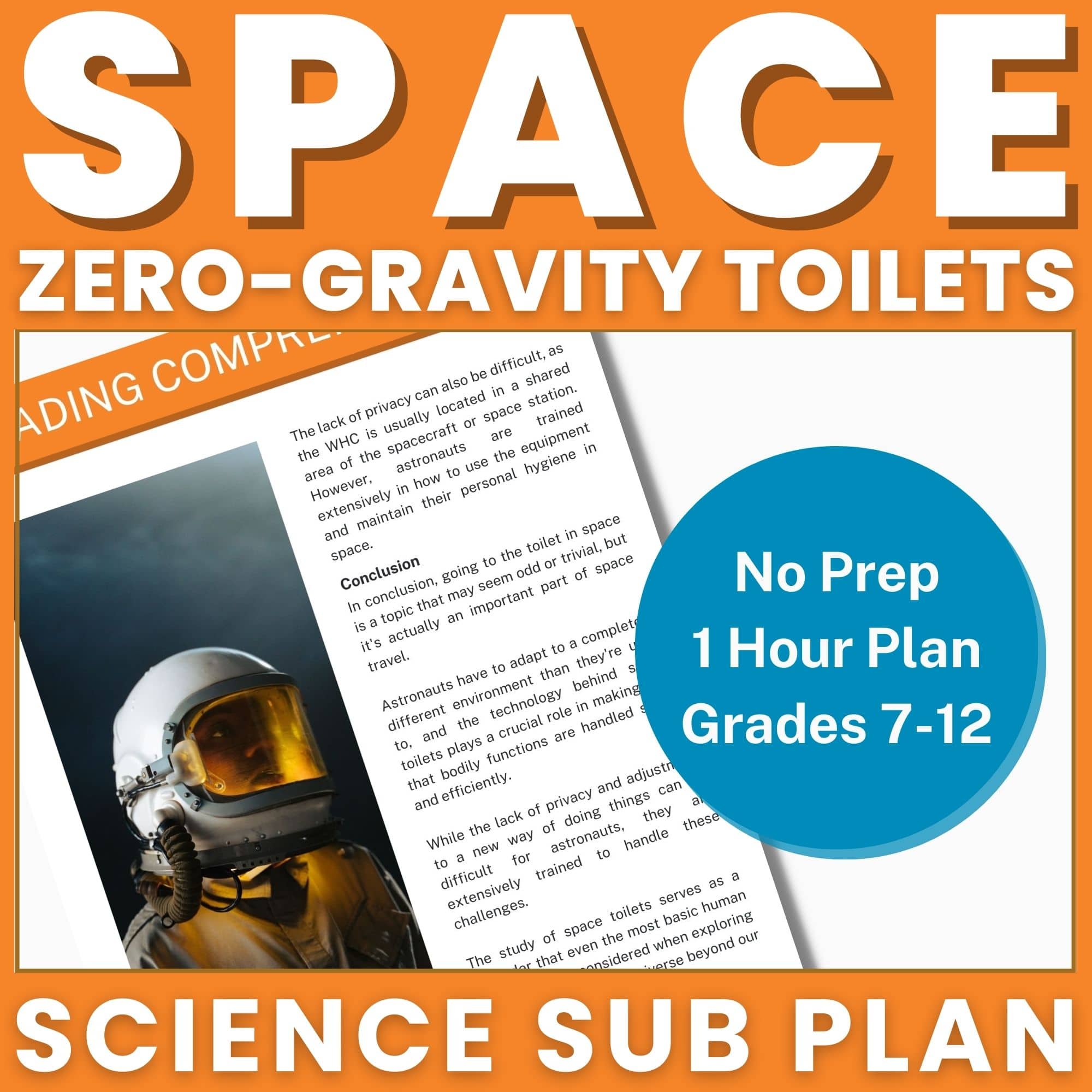
FREE Lesson Plan
The ultimate high-interest science lesson! Explore the engineering genius behind space toilets (UWMS), microgravity physics, and closed-loop water recycling. This free lesson pack includes engaging reading comprehension, ice-breaker questions, and fun activities to spark critical thinking and problem-solving in your secondary class.
Design Evolution: The Latest Universal Waste Management System (UWMS)
NASA's newest space toilet, the Universal Waste Management System or UWMS, is a huge leap forward in dealing with microgravity sanitation. It’s smaller, more power-efficient, and, crucially, much more comfortable to use. Why is it called ‘Universal’? Because it’s been specifically designed to accommodate both male and female astronauts more efficiently and effectively. Before the UWMS, design often favoured the male anatomy, leading to complications and difficulties for female crew members. The new design addresses this with better-positioned funnels and enhanced suction control.
One of the coolest things about the UWMS is its ability to handle pre-treat chemicals automatically, which helps to preserve the liquid waste before the recycling process begins. This is critical for preventing the build-up of bio-solids and maintaining the long-term health of the WRS. The new system even includes an automatic start-up sequence that initiates the airflow as soon as the lid is lifted. This might sound minor, but in microgravity, automatic suction is the difference between a clean flush and a floating disaster. It's a prime example of how user feedback directly influences engineering design in space exploration. You won’t have to waste time arguing about the importance of iteration when your students can see how many times NASA had to redesign their space toilet!
Key UWMS Enhancements
- Gender-Neutral Design: Single, integrated system that eliminates the need for multiple, complex attachments for the liquid funnel, making it easier for all astronauts.
- Titration and Pre-Treat: Automatic addition of chemicals to prevent growth and corrosion, optimising the waste for eventual recycling within the WRS.
- Reduced Mass and Power: The UWMS is 65% smaller and 40% lighter than its predecessor, a critical factor for deep-space missions where every kilogram counts.
It’s been fitted to the ISS and will be the model used on future missions, including those heading back to the Moon and on to Mars. When you think about the Apollo missions, where astronauts had to use literal bags and had no option for recycling water, you realise how far this technology has come. The evolution of the space toilet isn't just an anecdote; it's a measurable indicator of progress in long-duration spaceflight capability.
- Class Question: If you had to teach a brand-new astronaut how to use the UWMS in microgravity using only three simple, critical rules, what would those rules be?
How do astronauts go to the bathroom in space? It’s all about high-tech physics and suction! Teach your students about waste management in zero-G. #ScienceTeacher #SpaceScience #PhysicsFun @inspirationalscienceforsubs
Beyond the Space Toilet: What Happens to the Solid Waste?
The fate of the solid waste is less glamorous than the sophisticated water recycling, but it’s still an interesting logistical challenge tied to orbital mechanics. Because there is no recycling of solid human waste on the ISS, it all has to be carefully stored. The collected waste, which has been vacuum-sealed and compacted in those little bags inside the space toilet, is stored in aluminium containers. These containers are then loaded into the spacecraft that regularly bring supplies up to the ISS.
These supply vehicles, such as the Russian Progress or the SpaceX Dragon, are not all recovered. Many of them are designed to be disposable cargo ships. After they are unloaded, they are typically filled up with non-essential trash, which includes the stored human waste. The spacecraft is then de-orbited—meaning it’s commanded to fall back towards Earth. As the vessel re-enters the Earth's atmosphere, the intense friction and heat cause it to burn up, completely destroying the vehicle and its contents, including all the solid waste. It's a neat, self-cleaning solution to what would otherwise become a major storage problem.
The Problem of Stinky Storage on a Spacecraft
Imagine having to live with your rubbish for six months or more. Not appealing, right? That’s why proper sealing and compaction are so vital. The entire cabin environment of the spacecraft must be meticulously managed to keep the air clean and breathable. The systems need to ensure zero leaks and absolutely no microbial contamination. If any odours were to escape from the solid waste storage, the astronauts' quality of life would plummet very quickly, and they'd face a major distraction from their scientific work. This is another layer of engineering where things like air filtration, charcoal filters, and robust sealing technology become mission-critical. It's science meeting sanitation in a very cramped tin can!
- Class Question: For a long-term, self-sufficient colony on the Moon, where waste cannot simply be burned up in the Earth's atmosphere, how could you propose to safely and sustainably deal with the solid human waste? Would you suggest burial, composting, incineration, or something else entirely? Explain your reasoning, keeping in mind the need to protect the spacecraft environment.

Enjoyed the article?
Final Thoughts on Microgravity Sanitation
So, there you have it. The secret life of the space toilet—a fantastic blend of vacuum technology, advanced water recycling, and clever microgravity engineering. It’s far more than a simple bathroom; it’s a mission-critical piece of life support that highlights the incredible lengths scientists and engineers go to keep humans alive and comfortable far from our own planet. This is the kind of practical, surprising, and just-a-bit-gross science that really captivates students. It takes the abstract ideas of fluid dynamics and pressure systems and anchors them to something every single person can relate to.
You've learned that solids are sucked into sealed bags and burned up on re-entry, and that liquids are cleaned via complex vacuum distillation for recycling into drinking water. The newest UWMS is setting the standard for future long-duration missions, proving that even the most basic human needs require ingenious solutions when you’re exploring the cosmos. You won't have to waste time trying to make physics exciting when you can use the incredible journey of a drop of astronaut urine as your central teaching point. Hopefully, this content will help you save time and inspire your students, igniting a love of learning that goes beyond the textbook.
What’s the most surprising detail about the space toilet or the recycling system that you plan to bring up in your next class? Let us know in the comments!