

You know, sometimes the simplest, most everyday creatures hold the most amazing secrets. Think about it: how many times have your students squealed or gasped when they see an eight-legged critter? That reaction is a brilliant starting point for science! Today, you're going to get some truly captivating facts about spiders, facts that will transform that squeal into wide-eyed wonder. Forget those old stories about big, scary monsters; spiders are actually tiny engineering geniuses, essential to our world, and living right next door!
You’ll find that using these surprising titbits is a perfect way to spark critical thinking and problem-solving in your classroom. At Inspirational Science For Subs, our goal is to give you innovative resources so you can easily ignite a love of learning in your students. Trust me, you won’t have to waste time re-explaining the same thing when you've got amazing facts on hand. You’ll be able to move beyond the textbook and beyond limits with these brilliant spider details. Let's lift the lid on these fascinating neighbours and get you ready to inspire your young scientists!
More...
The Sticky, Silky Science of Spiders’ Webs
It's one of nature's best bits of engineering, isn't it? The humble spider web. Now, you might think a web is just a big tangle of thread, but that couldn’t be further from the truth. These creatures are master chemists and builders! The silk that comes out of a spider is a liquid protein, and it changes to a solid thread as it's pulled out. Isn't that wild? Think about squeezing toothpaste from a tube; the silk works a bit like that, but it's much, much stronger.
Why Spider Silk Is Tougher Than Steel
Hold on a minute, did you just read "stronger than steel"? Yes, you did! If you took a piece of steel the same thickness as a spider thread, the silk would be way more durable. It's incredibly light and elastic, too. Some kinds of silk can stretch up to 40% of their original length without breaking. Imagine a football net that could stretch that much and still catch the ball! These threads are the ultimate combination of strength and stretchiness. This super-material is why people have spent years trying to copy it in a lab – for things like lightweight safety gear or even strong, medical stitches. Just one tiny spider has given scientists a huge puzzle to solve!
But here’s a funny thing: not all of the threads in a web are sticky. The spider itself needs to walk around its own trap without getting stuck. So, it makes two types of silk. The strands that radiate out from the centre (the 'spokes' of the wheel) are usually non-sticky, allowing the spider highway to work perfectly. The circular strands—the ones that spiral around—that’s where the super-sticky glue is placed to catch insects. Pretty clever, eh? They build a perfect, custom-designed trap and then plot the safe paths right through it!
So, here's a thought for your class: If you could invent something using silk that’s tougher than steel and super stretchy, what problem would your invention solve?
Eight Legs, No Wings: The Body Plan of Spiders
When you look closely at a spider, you'll notice it's completely different from an insect. This is a common point of confusion for young scientists, but it’s a brilliant way to practise observation and classification skills. The biggest difference? Insects have three main body parts (head, thorax, and abdomen) and six legs. Spiders, on the other hand, belong to a group called arachnids and they only have two main body parts and—you guessed it—eight legs.
The Cephalothorax and the Abdomen
That first, biggest part of a spider's body is called the cephalothorax. It’s basically a fused head and chest, and that's where all the legs, the eyes, and the fangs are attached. The second part is the abdomen, which is usually rounder and a bit softer. That's the part that holds the silk-making glands, or spinnerets. These spinnerets are like little nozzles that let the spider shoot out its amazing silk. Isn't it fascinating how they pack so much function into two small sections? And get this: most spiders have eight eyes, though they don't all use them for the same things. Some jumpy spiders have excellent front-facing vision for hunting, while others use side eyes mostly to watch out for danger.
It’s easy to think of these tiny creatures as just one big blob, but when you break down their anatomy, you see how specialised they are. It’s a bit like learning the parts of a clock; every piece has its own special job. The legs, for instance, don't just walk. They have tiny hairs and claws that help them grip, feel vibrations in the web (telling them if dinner has arrived!), and even taste the air around them. That's a lot of multi-tasking for one tiny limb! You won’t find anything like that in the insect world.
Here’s a great question to get your class thinking about adaptation: If a spider had to survive in a place with no trees or surfaces to build a web on, what changes would you make to its body to help it catch food?
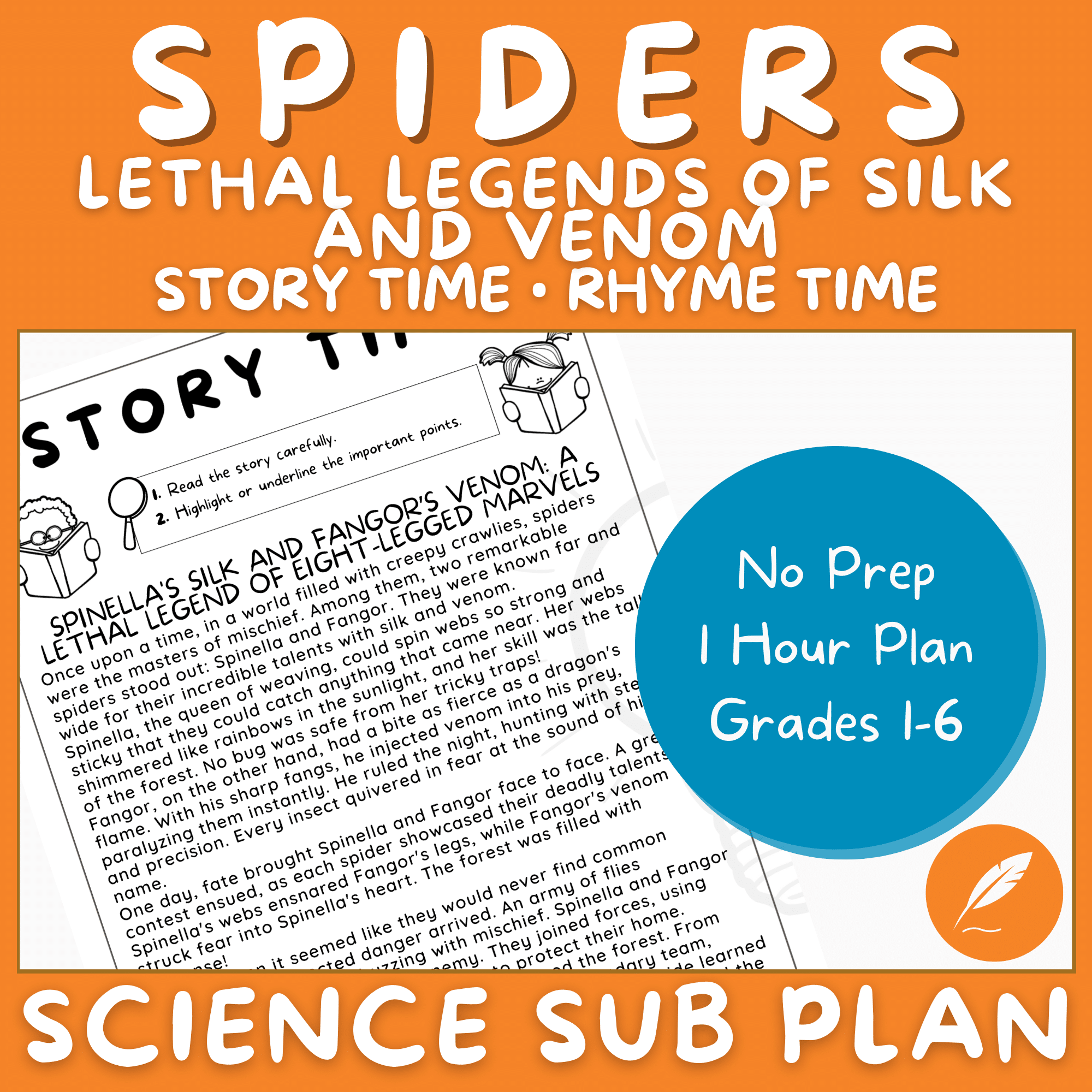
FREE Lesson Plan
Grab your free, engaging lesson plan: Spiders: Fascinating Facts About Our Creepy Crawly Neighbours! Perfect for US Grades 1–6. This resource helps students explore spider anatomy, spider silk engineering, and their vital role as pest controllers. Spark critical thinking and inspire science curiosity with fun activities.
Get your copy today!
The Truth About Spiders: Venom and Safety
Okay, let's tackle the big one: venom. Most people think of spiders as dangerous, scary attackers, but that's really more of a Hollywood story than a real-life one. Yes, spiders use venom. They need it to turn their dinner (usually an insect) into a sort of liquid meal that they can drink. But here's the absolute truth you can share with your students: the vast majority of spiders you find in your garden or local park are totally harmless to people. Their fangs are too small or their venom is far too weak to cause a human any serious trouble.
Are There Any Dangerous Spiders in the UK or US?
While you're teaching, it’s always helpful to be specific about where you live. For example, in the UK, there are practically no spiders to worry about. The False Widow is often mentioned, but its bite is usually no worse than a sting from a wasp. In the United States, things are a little different, with the Black Widow and Brown Recluse being the most well-known dangerous ones. But even they aren't looking to bite people! They only bite if they feel completely threatened, like when someone accidentally squashes them. Honestly, you're much more likely to be stung by a bee or wasp than bitten by one of these secretive spiders.
The best rule you can teach your students is simple: treat all wildlife with respect and caution. It’s fine to watch a spider build its web, but you shouldn't poke, grab, or try to keep them as pets unless a grown-up is helping you. These animals are much happier left alone to do their brilliant job of catching all those pesky flies and mosquitoes! They’re an important part of our local ecosystem, helping to keep other insect populations in check. Trust me, they're on your team!
Here’s a way to discuss conservation with your students: Why is it helpful to have spiders in your garden, and what simple thing could you do to make sure they can do their job safely?
Did you know a spider's web has sticky AND non-sticky threads? Mind-blowing spider facts for grades 1-6 that link to engineering & biology! @inspirationalscienceforsubs #STEM #ScienceLessons
How Spiders Help People and the Planet
It’s easy to focus on the 'creepy' part of a creepy crawly, but it’s time to shift the conversation to the good stuff. Spiders are absolutely vital! They’re the unpaid, highly efficient, and silent pest controllers of our world. Think about how many mosquitoes or crop-destroying insects there are; spiders eat millions of them every single day. Without them, we'd have a seriously tough time growing our food and enjoying a mosquito-free evening outside.
A Diet of Pests: Spiders’ Daily Job
You might be surprised by just how much a tiny spider can eat. It’s hard to get exact numbers, but scientists reckon that all the spiders on Earth eat hundreds of millions of tons of insects every year. That’s a staggering amount! That one little web outside your window is actually a tiny, high-tech piece of gear helping to manage local insect populations. From a farmer’s point of view, having plenty of spiders around is a fantastic sign of a healthy field because it means less need for chemical pesticides. This reliance on natural pest control is a great example of how nature balances itself out.
Beyond pest control, remember that incredible silk? That super-strong material could genuinely change how we make things in the future. Imagine surgical thread that’s unbelievably strong and safe for the body, or new kinds of cables or nets that weigh next to nothing but can hold huge amounts of force. It all started with a simple garden spider! You can even find fun craft ideas that mimic the strength and structure of a spider web, turning science into a fun, hands-on activity for your class.
For a fun science exploration, ask your class this: If you were a scientist studying spider silk, what would be the first question you’d try to answer about how they make it?
Enjoyed the article?
Summary: Inspiring Awe of Our Eight-Legged Neighbours
Wow, you’ve picked up some brilliant material today! Hopefully, these fascinating facts about spiders have given you plenty of ammunition to turn any classroom fear into genuine scientific curiosity. Remember, these eight-legged arachnids are the original chemists, engineers, and pest controllers of the natural world, spinning silk that puts our best technology to shame. You can help your students look past the 'creepy' factor and start appreciating the 'clever' factor.
You now have some fantastic ways to talk about anatomy, material science, and ecology, all through the lens of one small, common creature. This is exactly what we aim for at Inspirational Science For Subs: giving you the tools to go beyond limits and spark that limitless learning journey in every student. You’ll find that when you present science as amazing secrets about everyday life, your class becomes truly engaged. Which of these spider facts do you think will get the biggest reaction from your class? Let us know in the comments below! We love hearing how you inspire your young scientists.