

You might think of volcanoes as just fire and brimstone—pure destruction. But what if I told you that these explosive mountains are actually incredible laboratories for life? It’s true! Forget what you thought you knew about barren lava fields. You'll soon see that the study of volcanic ecosystems is one of the most exciting topics in science. It perfectly illustrates how Earth’s processes, even the most violent ones, lead to amazing growth. This post isn't just about rocks; it’s about persistence, adaptation, and how nature always finds a way to bounce back. You’ll be able to present your class with jaw-dropping examples of how volcanic ecosystems are born and thrive, fostering critical thinking and genuine exploration. I hope this content will help you save time and inspire your students with the sheer tenacity of life. Get ready to explore the stunning science behind how nature reclaims the earth after an eruption!
More...
Life Finds a Footing in Volcanic Ecosystems
It sounds completely bonkers, doesn’t it? A few years ago, there was molten rock flowing everywhere, and now there’s... something green? This is the miracle of primary succession, and it's what makes studying volcanic ecosystems so fascinating. Think about a lava flow: it cools down into solid rock, completely devoid of soil or nutrients. It’s an ecological blank slate. So, how does life begin here? The earliest pioneers are often tiny, unassuming organisms. You’ve probably heard of mosses and lichens, right? Well, these are the absolute heroes of the first act. They cling to the rock surface, slowly breaking down the tough minerals through chemical and mechanical weathering. It's a ridiculously slow process, but it’s foundational. Over time, as these tiny organisms live and die, their decaying matter mixes with the pulverised ash and rock particles. This creates the very first, basic soil layers—the fertile ground for future plants. Isn’t that just amazing?
Primary Succession in Extreme Environments
It takes real grit for life to thrive in volcanic ecosystems. You’re not dealing with a gentle forest floor; you’ve got intense heat gradients, poor nutrient availability initially, and often toxic gases venting nearby. That’s why the first species to colonise the area are known as extremophiles or pioneer species. They’ve evolved to cope with these incredibly harsh conditions. As the environment begins to stabilise, slightly larger plants, like ferns and grasses, can move in. These guys have deep root systems that help break up the newly formed rock even further and, critically, they hold the nascent soil in place, preventing erosion. Slowly but surely, the ecosystem shifts. The introduction of these plants provides shelter and food for tiny invertebrates and insects, beginning the slow but unstoppable march toward a fully functioning habitat. It's a brilliant example of patience in nature.
Question for your class: If you were a scientist tasked with speeding up the recovery of a volcanic ecosystem, what three things (beyond just planting seeds) would you try to introduce first, and why?
Unique Life Forms Found in Volcanic Ecosystems
When you discuss biodiversity with your students, you usually talk about rainforests or coral reefs. But hold on! Volcanic ecosystems offer some of the most unique biological adaptations on the planet, making them critical hotspots for speciation. Because volcanoes are often isolated (think of remote islands or mountain peaks), the species that evolve there don't face the same pressures or competitors as those in continental areas. This isolation, combined with the extreme environmental stress, pushes evolution into overdrive. Take for example, the incredible flora found near the geothermal vents. The soil can be steaming hot, yet plants called geothermal heat tolerators are perfectly comfortable, using the heat to their advantage!
Heat Tolerant Species and Endemism
Endemism is another huge feature of these areas. This means that certain species are found nowhere else on Earth. The Hawaiian silversword, for instance, lives only on the slopes of certain volcanoes. It’s got a special coating of silvery hairs that reflect the intense sunlight and protects it from the cold nights at high elevation. What a clever adaptation! The unique chemistry of volcanic soil—rich in certain minerals, but often poor in others—forces plants to develop unusual strategies for nutrient uptake. You’ll find creatures, too, that benefit from the warmth. Specific types of nesting birds on volcanic islands sometimes use the heat generated by the earth to incubate their eggs, saving them tons of energy. When you think about the pressure of survival, you realise how ingenious these volcanic ecosystems truly are. It’s an open-air laboratory for natural selection.
Question for your class: Imagine a scientist discovers a previously unknown bird species living solely inside the crater of an active volcano. What three specific adaptations do you think this bird might have developed to survive in that unique, dangerous microclimate?
FREE Lesson Plan
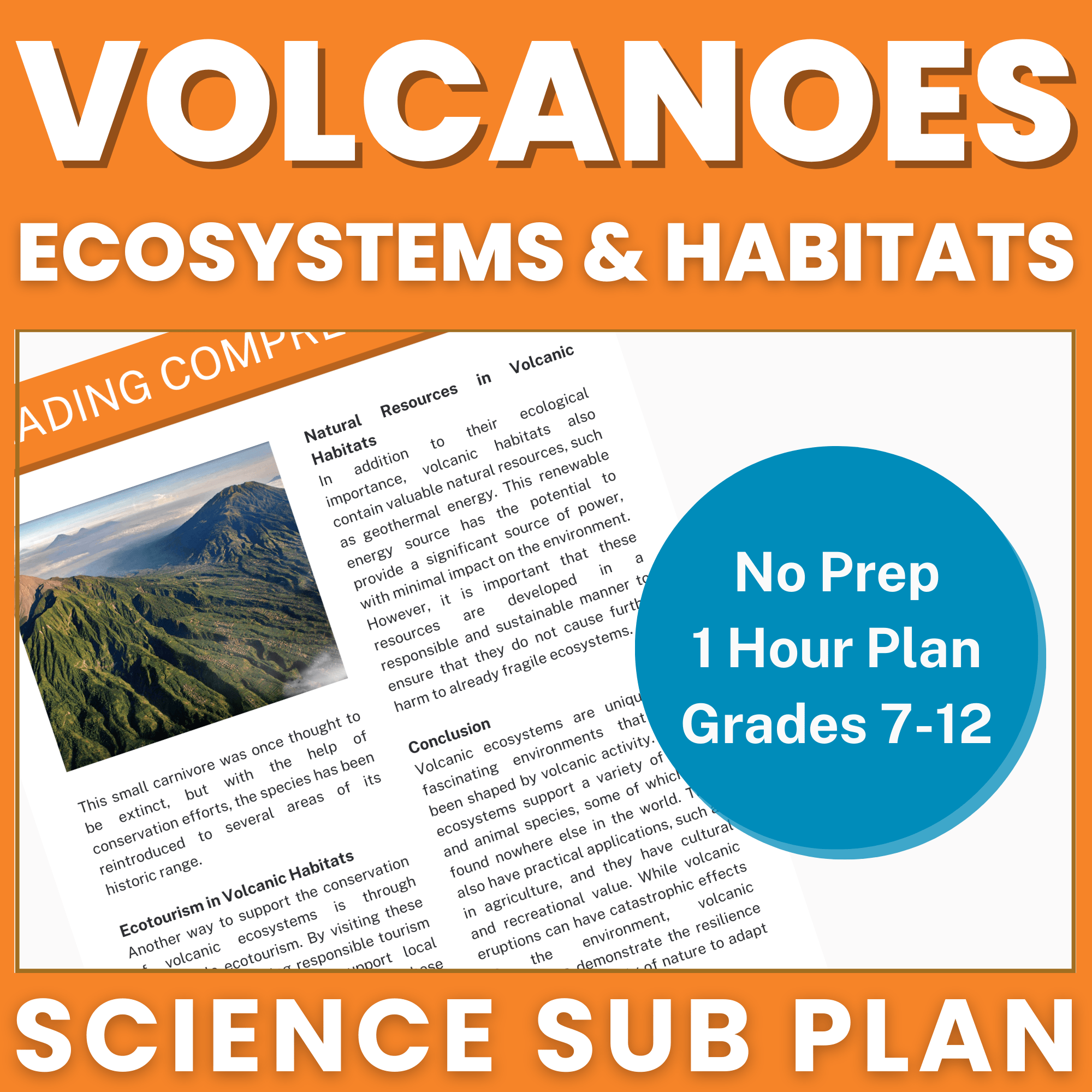
Stop wasting time searching for innovative Science resources! Grab this completely FREE lesson plan on Volcanic Ecosystems. Your students will explore primary succession, unique endemic species, and how nature brilliantly reclaims the earth after an eruption. This resource promotes critical thinking and provides ready-to-use discussion questions. Instantly inspire your class with the power of adaptation and geological cycles.
Geological Processes Driving Ecosystem Recovery
It’s easy to focus only on the biology, but the geology is the true engine of recovery in volcanic ecosystems. The type of eruption drastically changes how quickly the land recovers. A fast-moving, thin lava flow might cool quickly into smooth rock, which is actually quite difficult for plants to colonise. But a slow, thick, chunky lava flow creates lots of cracks and crevices. These spaces are brilliant because they trap wind-blown seeds, organic matter, and moisture. That’s why you might see life taking hold faster in one area than another right next to it! Then there’s volcanic ash. Ash sounds bad, but it’s often fantastic for future soil. It’s full of minerals, including important elements like potassium and phosphorus. Over time, rainwater leaches the nasty toxins out, leaving behind a mineral-rich foundation.
The Role of Ash and Mineral Cycling
This mineral content is why some of the most fertile farmland in the world is found right next to active or dormant volcanoes. Think about the agricultural regions around Mount Vesuvius in Italy, for example. Centuries of ash deposition have created incredibly rich soil. This demonstrates a core concept: destruction is often tied to creation. The eruption destroys the existing habitat, yes, but it completely resets the conditions, providing the essential building blocks for the next, often stronger, volcanic ecosystem. This process of mineral cycling is key to understanding why life can spring back so vibrantly. The earth is essentially providing itself with a nutrient boost! It's such a dynamic system.
Question for your class: If two volcanoes erupted simultaneously, one producing thick lava and the other fine ash, which area do you predict would show signs of life first and why?
Life after lava? Volcanic ecosystems are the ultimate lesson in resilience, adaptation, and primary succession. Get facts for your classroom! #SciEd #Biology @inspirationalscienceforsubs
Water and Climate in Volcanic Ecosystems
You cannot discuss volcanic ecosystems without mentioning water. Water, or the lack thereof, is often the biggest factor determining recovery speed. Volcanic landforms, especially those in tropical areas, are fantastic at trapping moisture. As wind blows air up the slopes of a volcano, the air cools, forming clouds and mist. This is called orographic precipitation. The volcanic soil itself, often being porous or full of cracks, acts like a massive sponge, holding onto rain and releasing it slowly. This steady supply of water is crucial for seedlings and young plants, particularly in the initial, fragile stages of the volcanic ecosystem development.
Thermal Vents and Unique Aquatic Habitats
But water isn’t just for drinking! You must remind your students about the incredible thermal environments. Areas where geothermal heat meets groundwater create hot springs, fumaroles, and geysers. These unique aquatic habitats support entirely different types of life—often chemosynthetic bacteria that don't rely on sunlight for energy. They use the chemical energy found in the super-heated, mineral-rich water. This concept is mind-blowing for students! It shows that life isn't just restricted to the surface; it’s happening beneath, powered by the planet’s internal heat. Understanding how water flows and interacts with the heat and rock is fundamental to understanding these extreme habitats. It’s a messy, complex, and beautiful interaction.
Question for your class: If a volcanic ecosystem is in a desert region, what specific geological feature could you look for that might indicate where underground water sources are being trapped or heated?

Enjoyed the article?
Inspiring Students with Volcanic Ecosystems
So, why should you spend time on volcanic ecosystems? Because they’re the perfect way to teach big, abstract concepts—like resilience, adaptation, and geological time scales—in a really concrete way. Students get to see that life isn't fragile; it’s extraordinarily tough. When you look at a volcano, you're not just looking at a pile of rock; you're looking at a history book written in lava and ash, showing the cycle of destruction and subsequent re-creation. This is the ultimate lesson in critical thinking and problem-solving: how does life solve the problem of survival when all the rules seem to be broken? It forces them to look beyond the textbook.
Bringing the Science to Life in the Classroom
You could have students model the different stages of succession using different materials (sand for ash, small leaves for pioneers, etc.). Or, even better, have them research specific organisms endemic to different volcanic ecosystems, like those on the Galapagos Islands or Mount St. Helens. Trust me, learning about creatures that live on sulphurous steam vents is far more engaging than memorising textbook definitions. It promotes that spirit of exploration that we champion here at Inspirational Science For Subs. You won't have to waste time re-explaining the concepts because the examples are so naturally dramatic and inspiring!
Question for your class: If you could travel to any recently formed volcanic ecosystem on Earth to study its recovery, which one would you choose and what specific hypothesis would you try to test first?
Volcanic Ecosystems – Conclusion
Well, you’ve made it through the fire! Hopefully, you now see that volcanoes are not just agents of destruction, but vital architects of entirely new landscapes and homes. The study of volcanic ecosystems provides such a rich vein of material for exploring biology, geology, and environmental science all at once. You’ve seen how pioneer species kick-start the process, how endemic life thrives in the isolation, and how geological inputs—ash and water—are essential for recovery. It’s a powerful story of resilience, showing your students that even after the most devastating natural events, nature always begins the work of reclaiming the earth. That’s a lesson that goes far beyond the science classroom, isn’t it? Keep pushing the boundaries of learning, and you’ll keep inspiring those limitless journeys of exploration for your students. You truly won’t have to work hard to get them excited about this.
I really hope these ideas spark some great lessons for you. Which of these five major phases of volcanic ecosystems—pioneering life, endemic species, ash deposition, water/vents, or full recovery—do you think is the most difficult for students to visualise? Let us know in the comments below!