

Every teacher knows that mid-term slump. You walk into the lab, and instead of curiosity, you’re met with blank stares and "Is this on the test?" It is exhausting to constantly battle for attention, especially when you are already time-poor. At Inspirational Science For Subs, our mission is to ensure you have high-impact, "sub-friendly" tools that keep the learning alive without the 2:00 AM planning sessions.
In this expert roundup, we are pulling back the curtain on the "Engagement Reset." We’ve sat down with four classroom veterans to uncover their secret "whodunnit" strategies—from digital escapes to courtroom debates. Each section below features a highlight from their full interview; click through to the deep dives to grab a specific, high-value freebie from each teacher to use in your classroom today.
More...

Alyse Johnson-Chilla
Keystone Science
"My core mission has always been making science accessible for every student that walks through my door. I want to connect the science to their world and make it attainable for them to learn, access, and understand."
Solving the Mystery of Secondary Science Student Engagement
When you’re prepping for a substitute or facing a week where your "teacher energy" is low, you need a hook that doesn’t require a three-page equipment list. Alyse from Keystone Science uses a "puzzling phenomenon" strategy that turns every lesson into a "whodunnit." With a background in cancer research, she knows that the best scientific reasoning begins with a question that students actually want to answer.
Instead of lecturing on cell transport, Alyse presents the Potato Cube Mystery. By observing mass changes in simple potato slices, students are forced to ask: Why did this one shrink while the other grew? This shift from passive listening to active investigation is the secret to sustained high school science student engagement. It moves the heavy lifting off the teacher and onto the students’ natural curiosity.
Low-Prep Tools for Scientific Reasoning and Logic
These strategies are a dream for your substitute folder because they rely on student-led discovery rather than teacher-led delivery. Alyse recommends "Lesson in a Box" solutions, like her differentiated Human Feedback Loops. These activities allow students to act as biological detectives, identifying sensors and effectors to solve the mystery of how the human body maintains its internal balance.
By leaning into these inquiry-based methods, you can ensure your classroom remains a "thinking space" even when you aren't at the front of the room. Alyse proves that you don't need flashy gadgets to improve secondary science student engagement—you just need a mystery worth solving.
From digital escape rooms to "Life on Trial," level up your secondary science student engagement with these low-prep, high-impact strategies! @inspirationalscienceforsubs #EdTech #Gamification #ScienceEd

Katrina Harte
The Animated Teacher
"Science isn’t about rushing, but about slowing down, reading closely, and following each step exactly."
Cracking the Code: Digital Escape Rooms and Precision
If you’ve ever walked into a classroom only to find half the students staring blankly at the ceiling, Katrina Harte has the ultimate "whodunnit" solution. Katrina, the creative force behind The Animated Teacher, specializes in secondary science student engagement through the lens of precision and logic. Her secret? Using "precision labs" to train students to stop the "sabotage" of rushing through instructions.
Katrina’s signature "mystery" for new classes is the Rainbow Lab. It’s a low-stakes investigation where the only way to "solve" the mystery and get the correct result is through absolute measurement precision. Students quickly realize that success in science isn’t about speed; it’s about reading closely and following every step of the scientific reasoning process. This gamified approach ensures 100% participation, as students work through the "mystery" of the instructions to achieve the perfect result.
Visual Clues and No-Prep Logic Hits
From a "Low-Prep" perspective, Katrina’s methods are a lifesaver for your substitute folder. She emphasizes the power of visual anchors to solve the mystery of "forgotten" concepts. By providing clear, permanent references for complex topics like independent and dependent variables, she reduces student anxiety and boosts high school science student engagement.
Katrina proves that you don't need a massive budget to create an immersive experience; you just need to give students a mystery worth solving and the visual clues to find the answer. To help your students master these tricky concepts, Katrina is offering her Free Science Variable Posters—the perfect toolkit for any classroom investigator.
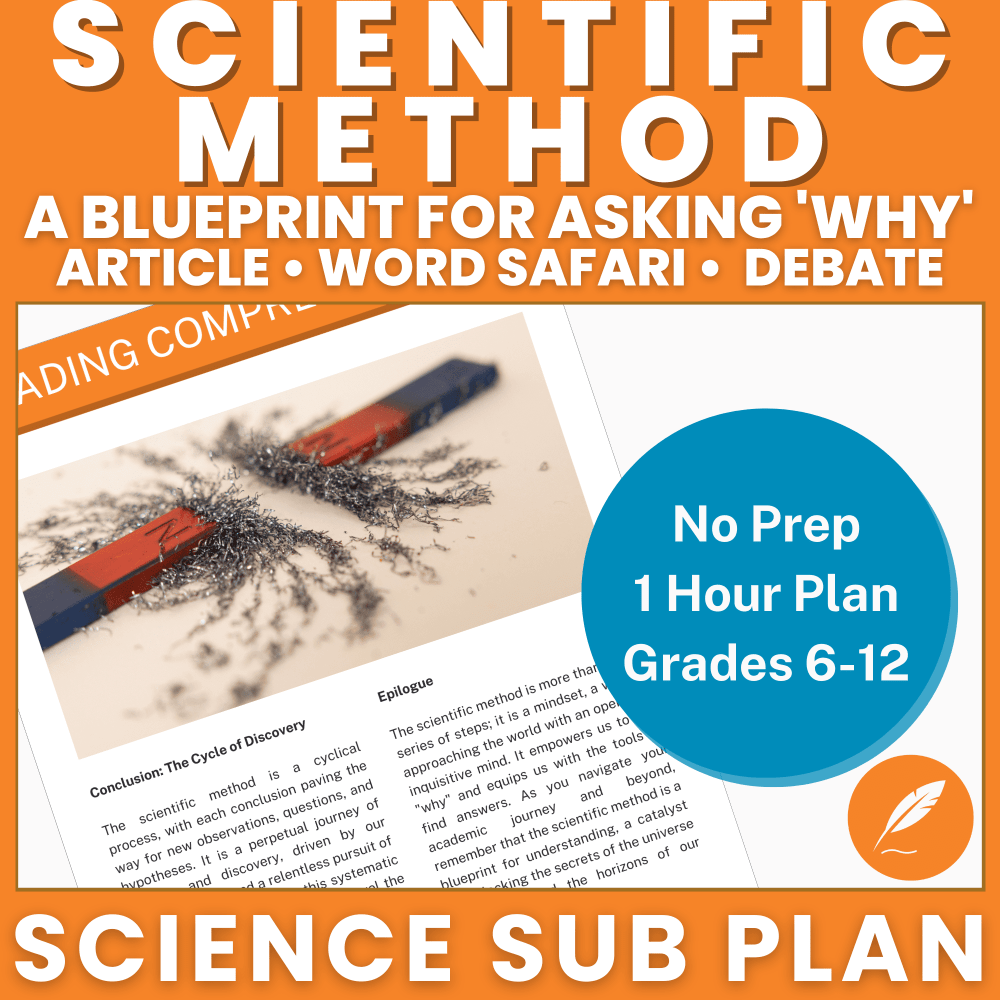
FREE Lesson Plan
This FREE Scientific Method Reading Comprehension and logic pack is the perfect foundational tool for secondary science student engagement. Featuring ice-breaker questions, a reading guide, and a word safari, it’s designed to turn passive readers into active investigators. Ideal for middle & high school science sub plans or as a "no-prep" hook for your next laboratory unit.
Download your copy and start cracking the code of scientific reasoning today!

Kasi and Jess
Surviving in Secondary
"Our mission is to help other educators not only survive, but thrive in providing engaging and unique curriculum supports for the secondary science classroom."
Level Up: Gamified Secondary Science Student Engagement
If you’ve ever wished your students were as obsessed with your lesson as they are with their favourite video games, Kasi and Jess from Surviving in Secondary have the ultimate "cheat code." Working in alternative education, they discovered that if you don't have a plan for engagement, you don't have a plan at all. Their "whodunnit" strategy centers on Life on Trial, a courtroom-style debate where students must use scientific reasoning to prove whether a mystery object is living or non-living.
The "No-Prep" Binary Puzzle for Scientific Logic
For the busy teacher, the real mystery is finding a way to gamify a lesson without hours of prep. Kasi and Jess are masters of the "low-prep" win, using self-checking digital tools that act as an instant "Lesson in a Box." These resources move the needle from passive learning to active participation by giving students immediate feedback—a crucial element for high school science student engagement.
To help you bring this competitive edge to your classroom, Kasi and Jess are sharing their Macromolecules Choose Two Digital Activity. This clever, binary-choice puzzle forces students to look at the "evidence" of molecular structures and make quick, logical decisions to move forward. It’s the perfect addition to a substitute folder, allowing a guest teacher to manage a high-energy, self-running quest while you’re away from the lab.
Enjoyed the article?

Laney Hill
Laney Lee Science
"My mission is to provide rigorous educational material for every topic in middle school science so that teachers always have somewhere to turn when they can't find the time to create high quality instructional materials on their own."
Cracking the CER Code: Scientific Reasoning
When middle schoolers hit a wall, it’s usually at the "Reasoning" stage of a scientific argument. Laney Hill from Laney Lee Science specializes in solving this specific mystery of middle school science student engagement. She understands that the jump from observing a fact to explaining why it matters is where most students get stuck. Her mission is to provide the "clues" and scaffolding necessary to turn every student into a confident scientific writer.
Laney’s "secret weapon" for mastering scientific reasoning is deep scaffolding. Instead of asking students to write from scratch, she provides versions of assignments where the claim or evidence is already provided, allowing them to focus entirely on the logic. By using "critique mode"—where students improve sample responses—she turns a writing chore into a puzzle. This shift in perspective is a massive driver for middle school science student engagement, as it lowers the stakes and invites every student to participate in the "detective work" of science.
Sub-Friendly Scaffolding and No-Prep Logic Hits
From a "Low-Prep" perspective, Laney’s resources are a goldmine for your substitute folder. She creates "rigorous but accessible" materials designed so that students rarely act up because they are doing work they can actually achieve. Her "complete the picture" drawings and zero-prep reading activities are perfect "Lesson in a Box" solutions. They allow a guest teacher to keep the room engaged with high-level scientific reasoning without needing a 40-slide PowerPoint or complex lab setup.
Laney proves that consistency is the key to classroom magic. By making CER a weekly routine and providing meaningful choices in how students show their work, she helps them take ownership of their learning. If you want to move your students from "I don't know" to "I can prove it," Laney’s scaffolding strategies are your essential toolkit for sustained middle school science student engagement.
Summary: Your Toolkit for Infinite Engagement
Reclaiming your classroom energy doesn't require a total curriculum overhaul. As our four experts have shown, the secret to secondary science student engagement lies in shifting the "detective work" back to the students. Whether you are using Katrina's digital locks, Alyse's puzzling phenomena, Kasi and Jess's courtroom debates, or Laney's logic scaffolding, you are building a "Thinking Classroom."
By stocking your sub folder with these "Lesson in a Box" strategies, you ensure that high-level scientific reasoning continues every single day—no matter who is at the front of the room.